Is Your Warehouse HVAC System Wasting Energy?
Warehouses and distribution centers use a tremendous amount of energy, and HVAC is often one of the biggest reasons utility bills keep climbing. In many facilities, the waste does not come from one dramatic failure. It comes from a long list of smaller problems that stack up over time. Poor airflow, open dock losses, bad controls, dirty filters, leaking ducts, and temperature stratification can all quietly push energy costs higher month after month.
If you are asking whether your system is wasting energy, there is a good chance the answer is yes. The better question is where that waste is happening and how quickly you can fix it. Improving warehouse HVAC efficiency starts with knowing the warning signs and understanding what they usually mean.
Need an expert evaluation? Choice Mechanical provides full-service HVAC-R support across Indianapolis and Central Indiana for warehouses, logistics hubs, and industrial facilities.
1. Your Team Is Using Personal Fans or Space Heaters
One of the clearest warning signs of poor warehouse HVAC efficiency is when employees stop trusting the building system and start bringing in their own solutions. If floor staff rely on portable fans in summer or space heaters in winter, the central system is likely failing to deliver conditioned air where it is actually needed.
- Dirty filters, coils, or fans may be choking off airflow
- Supply diffusers may be blocked by racking, pallets, or storage changes
- Duct leakage may be dumping conditioned air into ceiling space instead of the occupied zone
- Temperature stratification may be leaving the floor hot while the thermostat thinks conditions are fine
This is one of the easiest signs to overlook because the building still feels “operational.” In reality, the warehouse may already be wasting energy while failing to keep the people on the floor comfortable.
2. Dock Doors and Bay Openings Are Letting Conditioned Air Escape
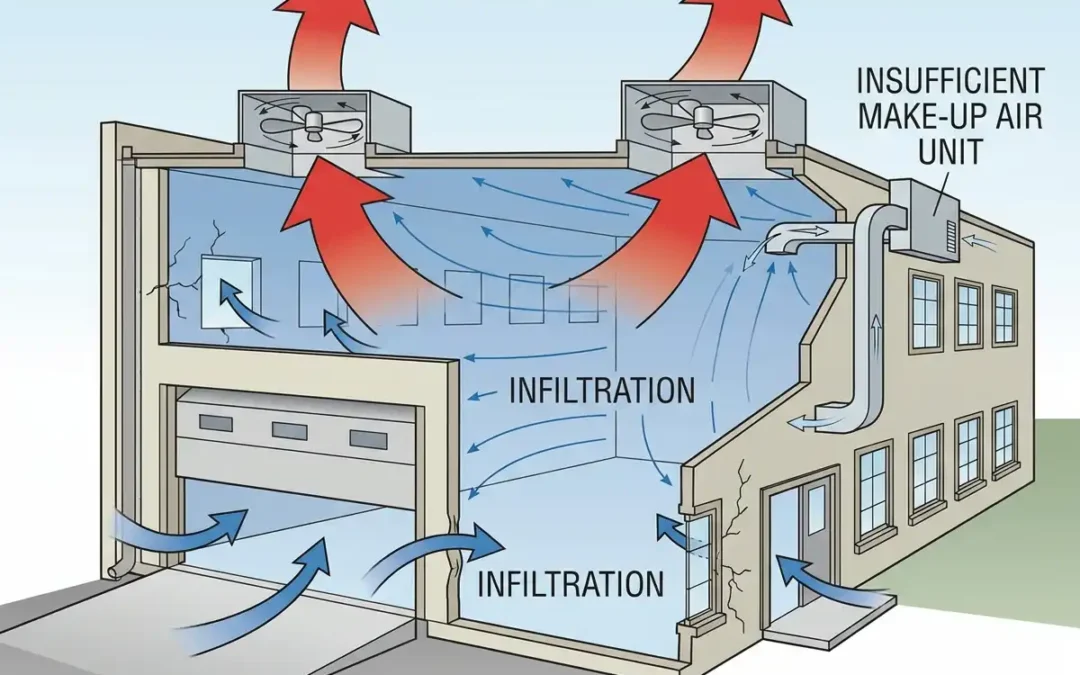
Loading docks are one of the biggest energy loss points in any warehouse. If dock doors are frequently propped open, seals are worn, or strip curtains are missing, the building may be bleeding conditioned air every hour of the day. In some facilities, poor building pressure makes the problem even worse by practically pulling air out through every opening.
- Make-up air may not be balanced correctly against exhaust systems
- Dock seals and shelter curtains may be torn or poorly maintained
- Air curtains, fast-closing doors, or strip curtains may be missing or ineffective
- Exhaust fans may be running longer than necessary, especially after hours
When dock conditions are working against the HVAC system, the building ends up conditioning outside air over and over again. That is a direct hit to energy efficiency.
If temperature instability near docks is already a problem, read how to control temperature fluctuations in large warehouse environments.
3. Temperatures Swing from Zone to Zone or from Day to Night
If one part of the warehouse feels like a sauna and another feels cold, your HVAC system may be running harder than it should while still underperforming. Wide temperature swings are one of the most common signs of hidden energy waste in large commercial spaces.
- Oversized units may be short cycling instead of running long enough to stabilize conditions
- Economizer dampers may be stuck open or set incorrectly
- Thermostats or remote sensors may be out of calibration
- Controls may no longer match the real occupancy pattern of the building
Short cycling is especially wasteful because the unit burns energy every time it starts up without staying on long enough to operate efficiently. Sensor drift and bad damper positions can be just as costly because the system keeps responding to the wrong information.
For a deeper look at setpoints, schedules, and building control strategy, read how to build a reliable HVAC infrastructure and questions facility managers should ask their HVAC contractor.
Ask us about control system review, sensor calibration, and zoning improvements for your warehouse.
4. Your Filter Change Schedule Is a Guess
In many warehouses, filter changes happen when someone remembers or when a filter looks obviously dirty. That approach usually leads to wasted fan energy, poor airflow, and unnecessary wear on the system. High-dust environments need a more deliberate plan.
- Loaded filters increase static pressure and force fans to work harder
- Guess-based replacement schedules often mean filters stay in too long
- Fiberglass throwaway filters rarely hold up well in dusty warehouse conditions
- Bypass gaps in filter racks can allow dust to move around the filter entirely
In some warehouses, filters need weekly attention until a predictable pattern is established. If your filter program is loose, the rest of the HVAC system is probably paying for it.
We can help you build a filter strategy based on real warehouse conditions instead of guesswork.
5. You Can Feel Drafts or Air Leaks Around the Building
Conditioned air that never reaches the occupied space is pure waste. Duct leaks, building envelope gaps, and roof or wall penetrations can quietly drain energy from the system all year long. In summer, humid outside air pulled into the building also increases the load on cooling equipment.
- Leaky ductwork can dump conditioned air into non-critical spaces
- Wall and roof gaps can pull in hot, cold, or humid outdoor air
- Poorly sealed penetrations increase infiltration and reduce control
- Air loss often becomes worse during windy conditions and heavy dock traffic
These issues are often written off as “just part of the building,” but they directly affect HVAC efficiency. If you are conditioning air that leaks out before it reaches the floor, your system is wasting energy every time it runs.
6. Unit Heaters or Infrared Systems Cycle On and Off Too Often
Repeated short heating cycles are a common sign of wasted energy in warehouse buildings. If gas-fired unit heaters or infrared tube heaters keep turning on and off without ever creating steady conditions at floor level, the system may be burning fuel without delivering the results you need.
- Thermostats may be located too close to a hot discharge stream
- Dirty fan blades may be reducing airflow and tripping high-limit conditions
- Infrared reflectors may be dust-coated and not radiating heat effectively
- The building may be losing too much heat through docks and infiltration points
Every startup cycle carries an efficiency penalty. When those cycles keep repeating, you are paying for heat that never really reaches the right place.
7. Your Energy Bills Spike During Mild Spring and Fall Weather
When energy bills jump during mild weather, the economizer is one of the first things worth checking. In many warehouses, “free cooling” should reduce compressor runtime during shoulder seasons. If it is not, the system may be missing one of its easiest savings opportunities.
- Economizer dampers may be stuck or disabled
- Outdoor air sensors may be reading incorrectly
- Changeover logic may not be set correctly for real building conditions
- The unit may still be running mechanical cooling when outside air could do the work
This is one of those problems that quietly burns money while everything still appears to be “working.” A failed economizer does not always shut the system down. It just makes it more expensive to run.
8. The System Runs Full Tilt Even When the Building Is Mostly Empty
Another major source of wasted energy is running the building in full occupied mode when the warehouse is lightly staffed or empty. Many facilities never update schedules after staffing, shipping windows, or weekend patterns change.
- Occupied mode may still be active on nights or weekends
- Temperature setbacks may be too narrow or never used at all
- Exhaust fans may be running after hours without process demand
- Old thermostats and control panels may not reflect current operating needs
Warehouses often have opportunities to widen the deadband during unoccupied periods without risking inventory or operations. If the building is still running at full speed when no one is there, you are paying for waste every hour.
9. Skipped Maintenance Lets Small Efficiency Problems Stack Up
Many warehouses waste energy because basic maintenance tasks keep getting deferred. Dirty coils, worn belts, misaligned dampers, and low refrigerant charge all reduce performance even if the system has not fully failed yet.
- Coil cleaning restores heat transfer and airflow
- Fresh filters reduce fan strain and improve delivery to the occupied zone
- Scheduled maintenance helps catch refrigerant, electrical, and control issues early
- Routine service reduces the chance that waste turns into downtime
That is why maintenance is not just about avoiding breakdowns. It is one of the fastest ways to improve warehouse HVAC efficiency without making a major capital investment.
Want to strengthen that side of the plan? Read the hidden cost of skipping maintenance on commercial HVAC systems and why every facility needs a 24/7 emergency HVAC partner.
Ask about our warehouse-focused maintenance and HVAC-R service programs.
Frequently Asked Questions
How can I tell if my warehouse HVAC system is wasting energy?
Look for uneven temperatures, rising utility bills, personal fans or heaters on the floor, uncontrolled drafts, open dock losses, short cycling equipment, and systems that run heavily when the building is mostly empty.
What are the best HVAC efficiency upgrades for a warehouse?
Common high-value improvements include zoning, smart controls, destratification fans, economizer repair, better dock sealing, and high-efficiency rooftop units or variable-speed equipment where appropriate.
Do warehouses need different HVAC strategies than offices?
Yes. Warehouses deal with higher ceilings, bigger open spaces, more dust, more infiltration, and stronger loading dock effects. That means airflow, controls, and maintenance need to be handled differently.
Can Choice Mechanical evaluate my current warehouse HVAC system?
Yes. We provide HVAC-R evaluations for warehouses and industrial facilities, including airflow review, control system checks, mechanical inspection, and guidance on reducing wasted energy.
Do Not Let Hidden HVAC Waste Drain Your Budget
Your HVAC system may be costing you more than it should. Between dock losses, outdated controls, poor airflow, dirty components, and zone imbalance, warehouse inefficiencies can quietly drain your budget month after month. The good news is that most of those issues can be identified and corrected with the right evaluation and a more proactive service plan.
Choice Mechanical Services specializes in improving warehouse HVAC efficiency for industrial and distribution facilities across Indianapolis and Central Indiana.
Contact us today to schedule a warehouse HVAC evaluation or energy-focused system review.