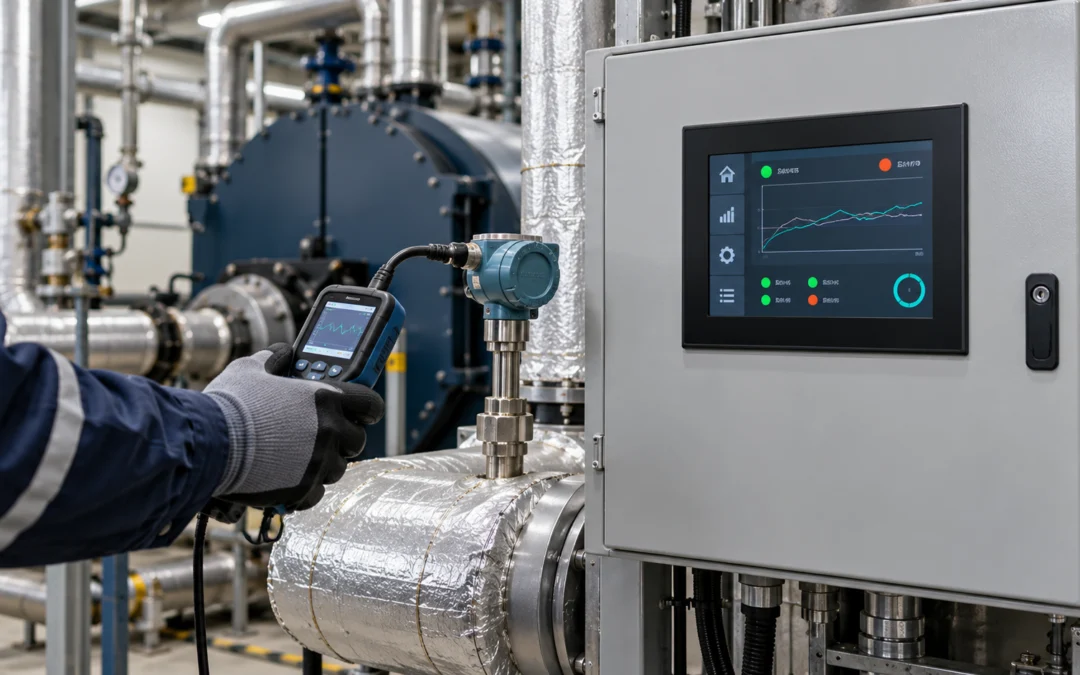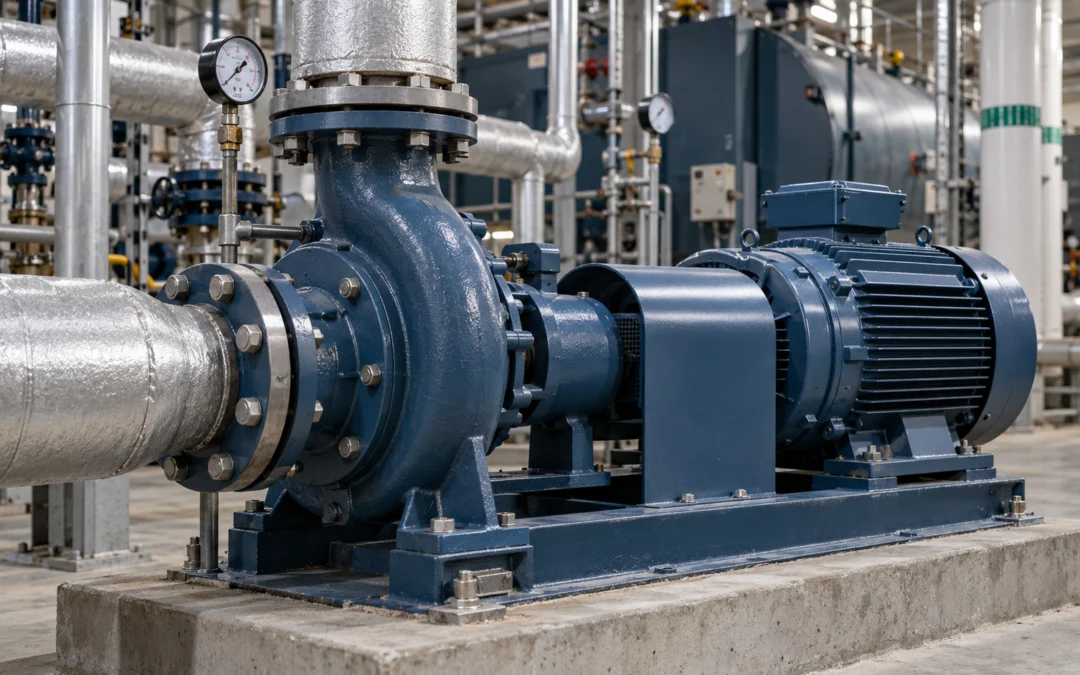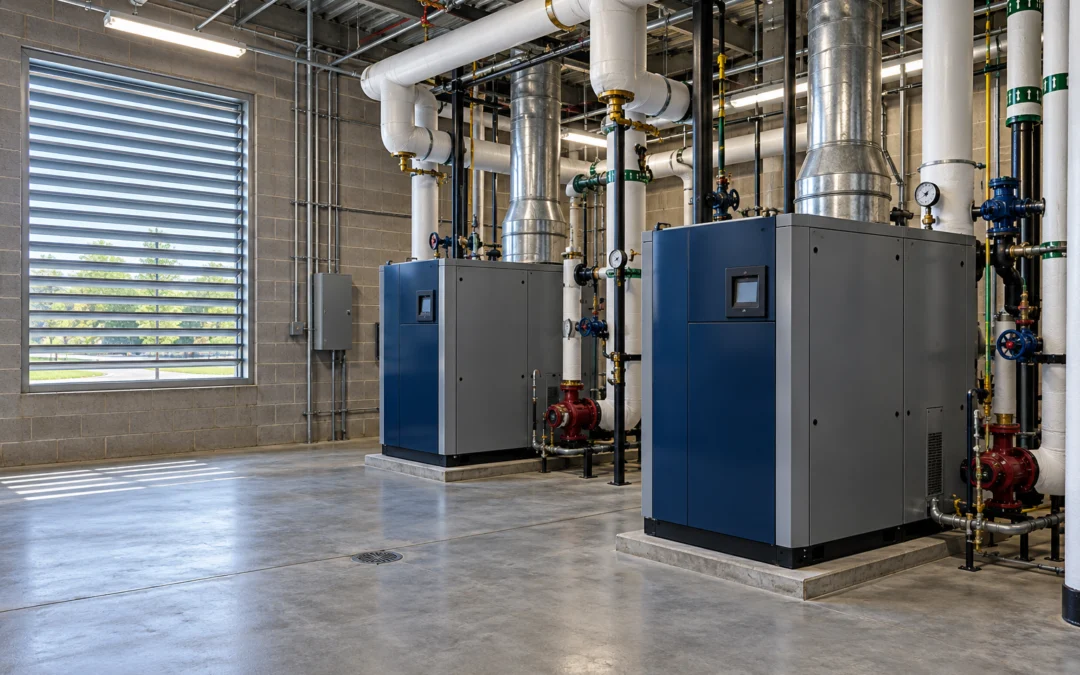
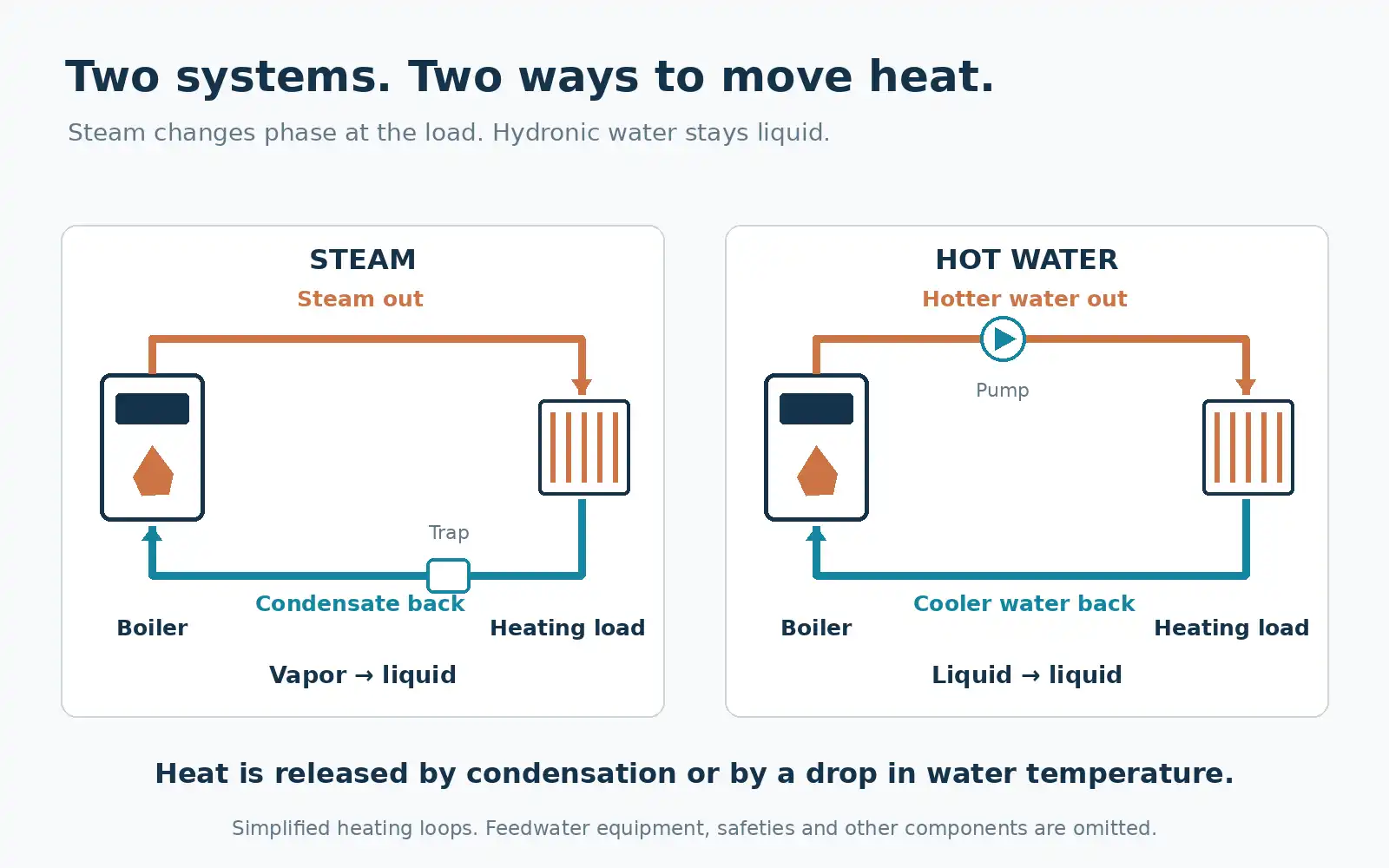
A steam boiler and a hot-water boiler can both heat a commercial building, but they move energy in fundamentally different ways. Steam carries latent heat as vapor and condenses at the load. A hydronic system circulates liquid water whose temperature falls as heat is transferred.
The right choice depends less on which boiler is “better” and more on what the facility needs to heat, the temperature required, the distribution system already in place, staff capability, water treatment, controls, redundancy, and the cost of changing infrastructure.
“The distribution system usually makes the decision before the boiler does. We need to know what the loads require and what changing the piping would involve.” says one of the lead boiler technicians at Choice Mechanical Services in Indianapolis.
Steam and Hot Water at a Glance
| Decision factor | Steam system | Hot-water system |
|---|---|---|
| Energy transport | Steam condenses and releases latent heat | Pumped water releases sensible heat as temperature drops |
| Common commercial uses | Process heat, sterilization, humidification, kitchens, legacy heating | Comfort heating, coils, radiant systems, domestic-water heat exchange |
| Distribution driver | Pressure difference and condensation | Circulation pumps |
| Terminal control | Steam valves, traps, pressure, vacuum or condensate behavior | Water valves, flow, supply temperature, pumps |
| Water management | Makeup, feedwater, blowdown, condensate return, steam quality | Closed-loop chemistry, air removal, expansion, makeup control |
| Low-temperature opportunity | Limited by steam requirement and distribution | Can support reset, condensing operation, and heat-pump integration when terminals permit |
When Steam Is More Than a Heating Medium
Facilities may require steam for sterilizers, humidifiers, process vessels, cooking, cleaning, drying, or direct injection. In those applications, replacing the steam plant with a hot-water boiler does not serve the same load.
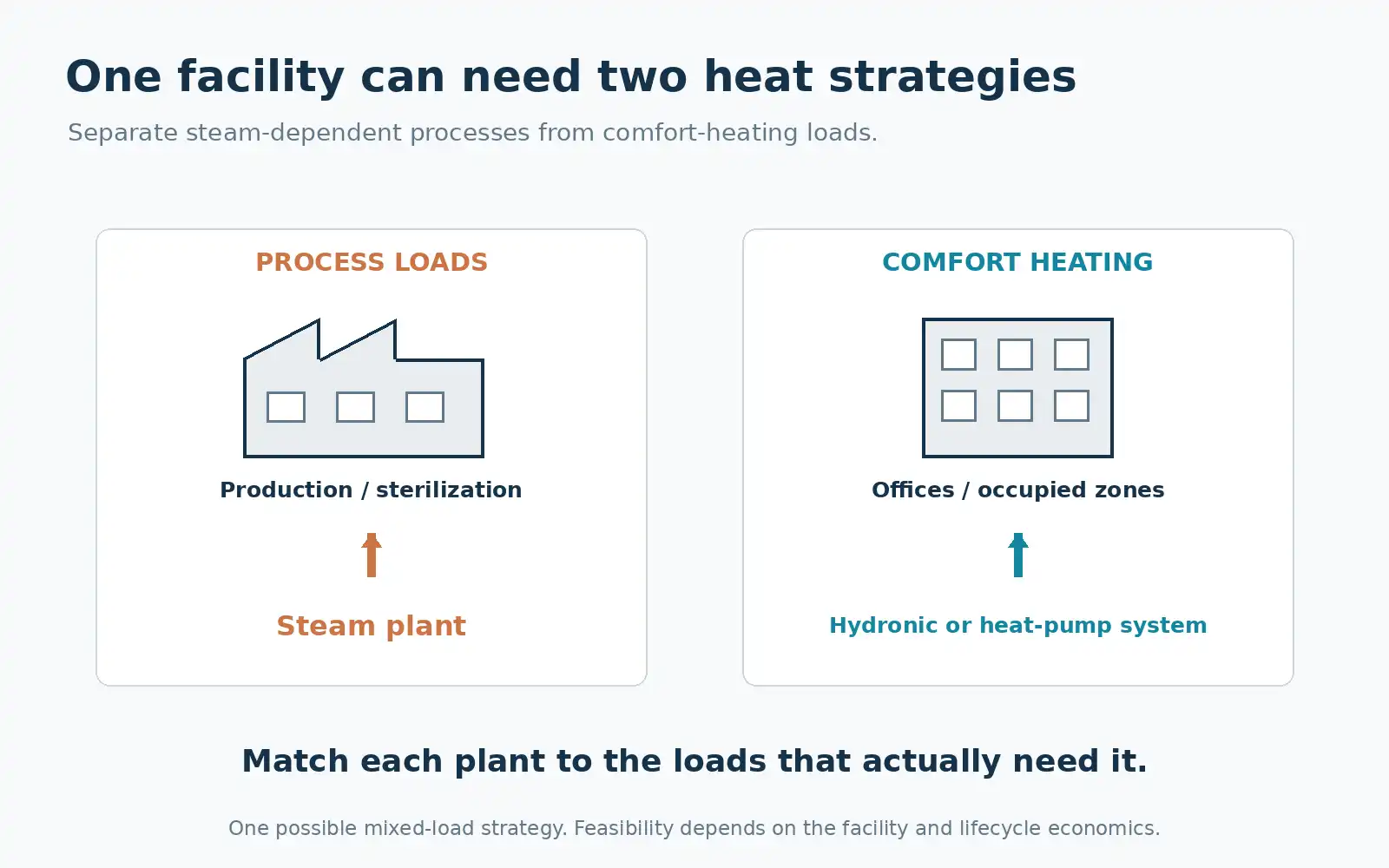
A facility can also have mixed needs. Process equipment may require steam while comfort heating can transition to hot water. Separating loads may allow the steam plant to operate for process demand instead of remaining active year-round for a small heating requirement.
Steam Distribution Has Unique Reliability Points
Steam must reach equipment, condense, and leave through properly selected traps and return piping. Air and noncondensable gases must vent. Condensate must drain with appropriate slope and pressure relationships. Failures can produce hammer, slow heating, trap loss, return corrosion, and unstable boiler level.
Steam systems reward disciplined trap surveys, leak repair, insulation, condensate recovery, feedwater treatment, blowdown control, and warm-up procedure. Their condition cannot be judged by the boiler alone.
Hot Water Offers Flexible Temperature Control
A hydronic plant can reset supply-water temperature according to outdoor conditions or demand, provided terminal units can meet load. Lower return-water temperature can support condensing-boiler efficiency. Variable-speed pumping can reduce distribution energy when flow and control are commissioned correctly.
Those opportunities depend on system details. Boiler minimum flow, coil and radiator capacity, valve authority, pump selection, bypass piping, expansion control, and freeze protection must be considered. A hot-water plant is not automatically efficient because it uses condensing boilers.
Do Not Compare Boiler Efficiency Ratings Alone
Published boiler efficiency is measured under defined test conditions. Facility performance also includes:
- Standby and cycling losses
- Distribution leakage or heat loss
- Pump, fan, and auxiliary energy
- Return-water or feedwater temperature
- Blowdown and makeup-water losses
- Controls, staging, and turndown
- Actual load profile
- Maintenance condition
Compare annual system performance and lifecycle cost rather than one nameplate number.
Existing Infrastructure Can Dominate Project Cost
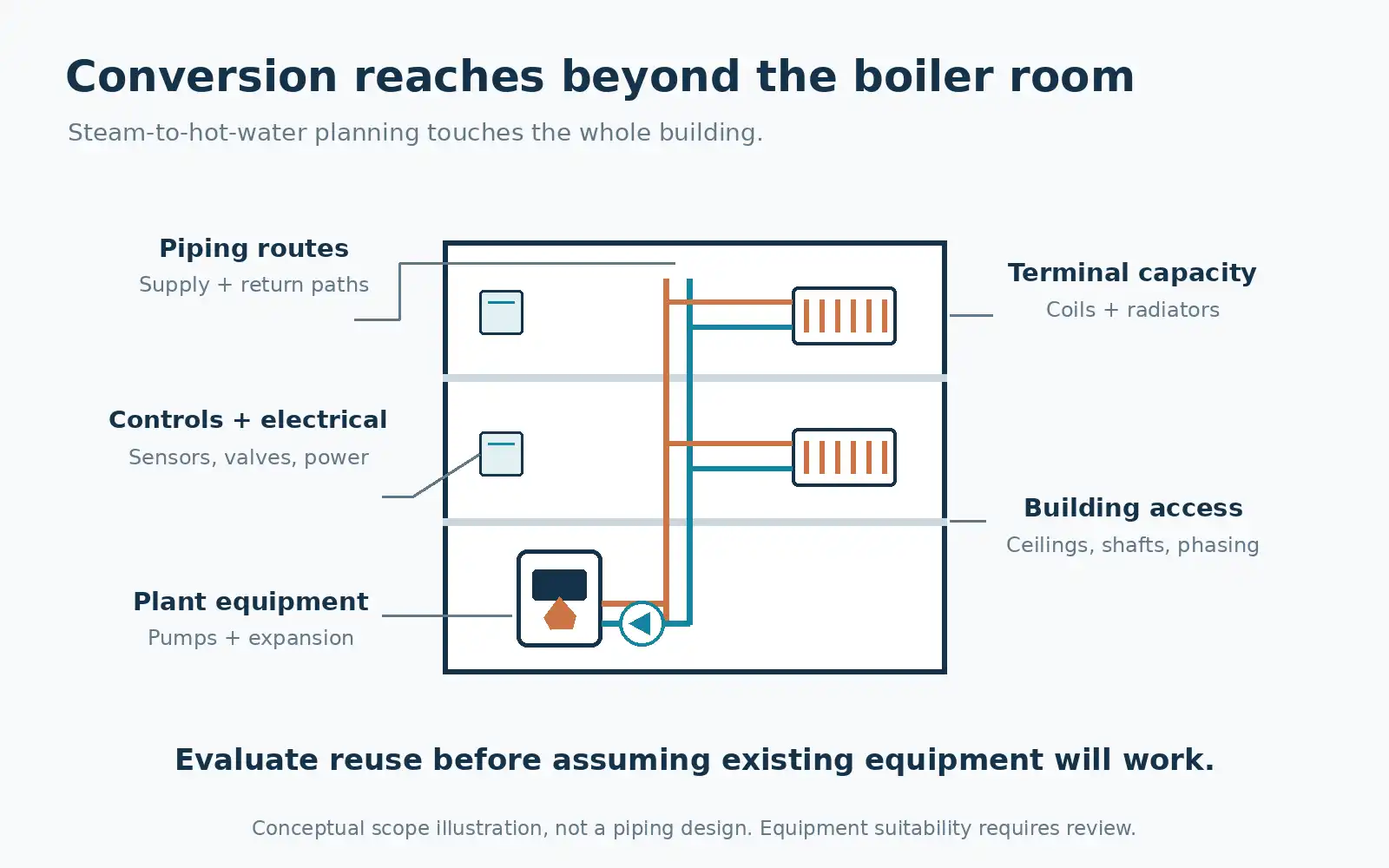
Converting a steam-heated building to hot water may require new supply and return piping, terminal units, pumps, expansion equipment, controls, shafts, ceilings, electrical work, and asbestos or architectural coordination. Some steam piping or radiation can potentially be adapted, but suitability must be evaluated rather than assumed.
Conversely, installing a new steam plant for a building that needs only moderate-temperature comfort heat may add complexity without a process requirement. New construction has more freedom to select distribution around the intended loads.
Example: A Facility With Process Steam and Office Heat
A Central Indiana food plant uses steam for production and also serves office heating coils from the same plant. During warm weather, the boilers operate at low load solely for a small process and occasional reheat requirement.
A planning study separates the load profile. Process steam remains essential, but office heating may be served by a hydronic or heat-pump system during renovation. The steam plant can then be sized and sequenced for the loads that genuinely require steam.
This representative example is not a universal recommendation. It shows why mixed-use facilities should map each load before selecting plant equipment. Choice Mechanical supports food-production mechanical systems and provides commercial boiler installation and repair across Indianapolis and Central Indiana.
Questions to Answer Before Selecting a System
- Which loads require steam, and which need only heat?
- What temperatures, pressures, and capacities are required by zone and schedule?
- What distribution piping and terminal equipment can be reused?
- What is the condition of existing pressure parts, traps, returns, pumps, and controls?
- How much redundancy does each critical load require?
- What water-treatment and operator capability is available?
- How will the plant perform at minimum and peak load?
- What outage, phasing, temporary heat, and access constraints exist?
- How do fuel, electricity, demand, water, sewer, and maintenance costs compare?
- Could envelope work or load separation change the answer?
“The best plant is the one that serves the load reliably at peak and remains controllable during the many hours when the building needs far less.” says one of the lead boiler technicians at Choice Mechanical Services in Indianapolis.
Steam-to-Hot-Water Conversion Is a Building Project
A conversion should evaluate structural and architectural conditions, piping routes, terminal capacity, controls, electrical infrastructure, ventilation, water chemistry, drainage, code, and temporary service. The old steam system may also contain materials or conditions that affect demolition and cost.
Phasing can be possible. A facility may convert selected zones, isolate process steam, add a hydronic secondary plant, or replace equipment as areas are renovated. The final system architecture should be planned before the first phase to avoid incompatible pieces.
Steam Boiler vs. Hot Water Boiler FAQs
Is a hot-water boiler always more efficient?
No. Efficiency depends on equipment, water temperature, load, controls, distribution, maintenance, and operation. Hot water may offer strong low-temperature opportunities, but design matters.
Can a steam boiler be converted to hot water?
Some equipment may be approved for specific conversion, while other boilers and systems are not suitable. Manufacturer, code, pressure-vessel, piping, control, and distribution requirements need qualified review.
Which system requires more maintenance?
Maintenance tasks differ. Steam adds traps, condensate return, feedwater, blowdown, and steam-quality concerns. Hot water adds pumps, expansion control, air removal, and closed-loop flow management. Condition and complexity determine effort.
Can one facility use both steam and hot water?
Yes. Mixed plants or heat exchangers can separate process steam from hydronic loads. Controls and lifecycle economics should justify the arrangement.
Which boiler type is better for an office building?
Many offices use hot-water systems, but existing infrastructure, building age, terminal units, renovation scope, and owner goals determine the best path.
Choose the Distribution Strategy Before the Boiler Model
Steam and hot water are tools for different loads. A sound selection maps what the facility needs, when it needs it, how energy reaches each load, and what infrastructure and staff will support the system for decades.
For facilities evaluating high-efficiency hot-water equipment, Choice Mechanical also supports AERCO boilers and water heaters. Selection still begins with verified loads, temperatures, flow, venting, and lifecycle requirements.
To compare commercial boiler options or plan an existing-plant replacement, call Choice Mechanical at (317) 885-0200 or request a boiler consultation. Bring load information, piping diagrams, equipment schedules, utility history, process requirements, and known distribution problems.