The Hidden Costs of Inconsistent HVAC Maintenance in Large Facilities
In large commercial and industrial facilities, the cost of inconsistent HVAC maintenance rarely shows up all at once. It builds quietly. A dirty coil here, a loose belt there, a skipped inspection, an ignored vibration, a filter that stayed in too long. None of those issues look catastrophic on their own, but together they create a slow financial drain that hits energy use, equipment life, productivity, indoor air quality, and long-term capital planning.
That is why the true cost of inconsistent maintenance is not just what you spend on repairs. It is what you lose before the problem becomes obvious. For large facilities across Indianapolis and Central Indiana, that hidden cost can be far greater than the annual maintenance budget that would have prevented it.
Need help building a preventative maintenance strategy? Explore our commercial HVAC Maintenance Agreements designed specifically for large buildings, campuses, warehouses, and industrial facilities in Indiana.
1. Inconsistent Maintenance Creates a Silent Energy Tax
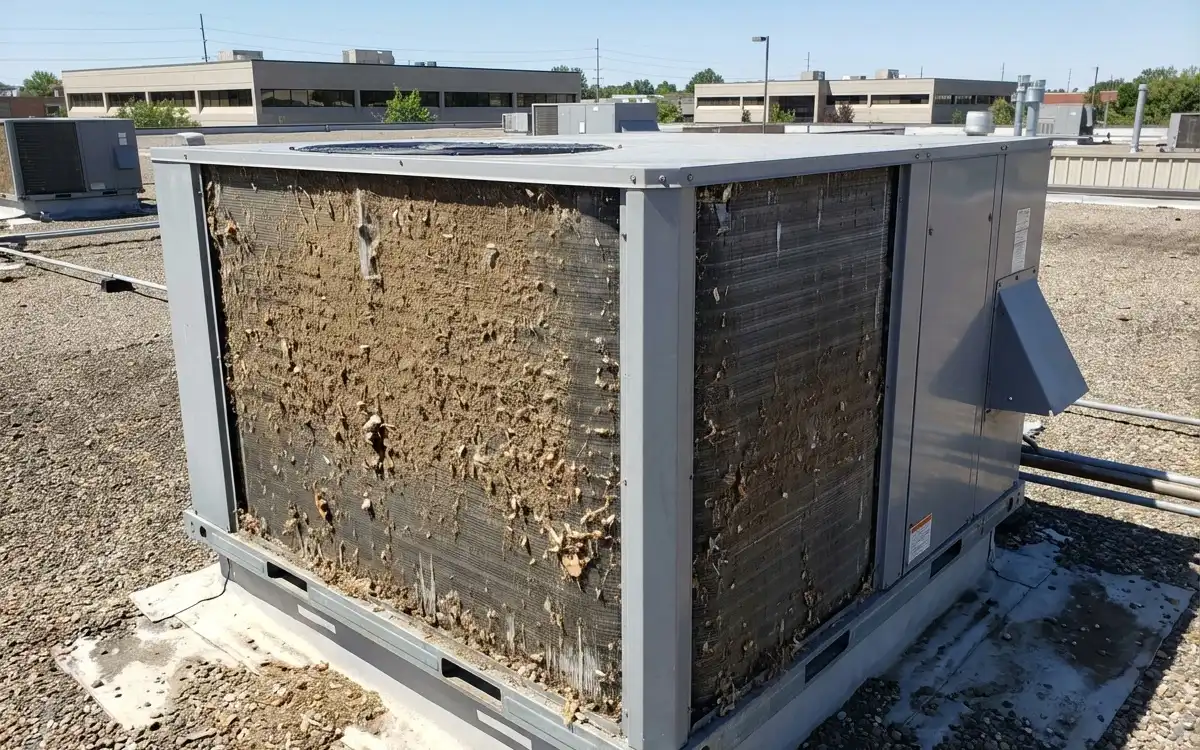
Large facilities can absorb a surprising amount of HVAC inefficiency before anyone notices. That is what makes inconsistent maintenance so expensive. The system keeps running, but it runs harder than it should. Dirty coils reduce heat transfer. Clogged filters increase static pressure. Slipping belts cut airflow. Mis-calibrated sensors and stuck dampers make the system condition more air than the building actually needs.
- Light coil fouling can drive longer compressor runtimes and higher energy use
- Bypassed or neglected filters allow dust to coat blower components and reduce fan efficiency
- Economizer dampers that drift or stick can create unexplained spring and fall energy spikes
- Loose belts and airflow loss quietly increase fan and motor electricity use
In a large building, those losses compound. What looks like a weather issue or a utility-rate issue is often a maintenance issue hiding in plain sight. One year of deferred attention can turn into thousands of dollars in avoidable waste.
Ready to improve HVAC efficiency? Learn more about our commercial HVAC-R services and let’s find out where your building is quietly overspending.
2. Equipment Life Gets Cut Short Long Before Replacement Is Planned
Large-facility HVAC equipment is expensive because it is built to do serious work over a long service life. But that life expectancy assumes regular maintenance actually happens. When maintenance becomes inconsistent, the system carries more stress every season, and the result is early equipment failure that eats into the capital budget.
- Dirty condenser coils drive up head pressure and overwork compressors
- Unbalanced fans and worn belts damage bearings, shafts, and motors over time
- Restricted airflow can overheat heat exchangers and shorten equipment life
- Neglected water-side equipment can scale up, corrode, and lose performance years early
This is where deferred maintenance starts hurting long-range planning. Replacing a rooftop unit or major central plant component years ahead of schedule does not just create a repair problem. It disrupts the capital plan and forces ownership to spend money that should have gone to other facility priorities.
3. Repair Costs Multiply When Maintenance Becomes Reactive
Reactive maintenance is always more expensive than planned maintenance, but the difference is especially brutal in large facilities. Once the building moves from routine service into emergency mode, labor rates rise, parts get expedited, access becomes urgent, and failures often spread beyond the first component.
- Emergency labor often comes with after-hours or weekend pricing
- Expedited shipping and emergency sourcing drive parts costs higher
- Missed small failures often trigger larger collateral damage
- Temporary cooling or heating rentals can quickly erase any “savings” from skipped maintenance
This is why inconsistent maintenance usually produces a 3x to 5x multiplier on repair costs over time. The building stops paying for predictable service and starts paying for urgency, downtime, and failure cascades at the worst possible moment.
Need a fast response when problems escalate? We provide 24/7 emergency HVAC services across Indianapolis and Central Indiana.
4. Downtime Costs More Than the Mechanical Repair
In large facilities, the HVAC invoice is often not the biggest number tied to a failure. The bigger cost comes from what the outage does to operations. When indoor conditions drift out of spec, work slows down, people get uncomfortable, processes are interrupted, and business obligations start to stack up.
- Offices lose productivity when staff are working in poor conditions
- Warehouses and industrial facilities can lose throughput when heat, humidity, or poor airflow interfere with operations
- Retail and customer-facing spaces risk a direct hit to experience and reputation
- Healthcare, lab, and temperature-sensitive operations can face far more serious operational exposure
In many buildings, this is the cost that never gets booked to the HVAC line item even though HVAC is what caused it. That is one reason large facilities need to treat maintenance as an operational protection strategy, not just a service expense.
5. Indoor Air Quality Problems Quietly Hurt People and Performance
Inconsistent HVAC maintenance does not just affect equipment. It affects the people inside the building. Dirty filters, wet coils, stagnant drain pans, and weak ventilation can all degrade indoor air quality in ways that are easy to ignore until complaints, illness, or liability show up.
- Mold and biological growth can develop in wet or poorly maintained components
- Dirty filters and duct systems allow particulates and VOCs to stay in circulation
- Weak ventilation can raise CO2 levels and contribute to drowsiness and reduced focus
- Poor air quality can affect absenteeism, morale, and occupant trust
Large facilities often feel these effects before they fully understand the source. People describe the building as stuffy, inconsistent, or harder to work in. Over time, that becomes a productivity problem, a tenant-confidence problem, and sometimes a legal problem.
If your facility is already dealing with that side of HVAC performance, you may also want to read How HVAC Failure Can Jeopardize OSHA Compliance in Commercial Facilities.
6. Compliance, Warranty, and Insurance Risk Get Worse When Documentation Is Thin
Another hidden cost of inconsistent maintenance is that it weakens your documentation exactly when documentation matters most. If a refrigerant leak, humidity issue, indoor air quality complaint, or equipment failure turns into a claim, inspection, or warranty dispute, missing maintenance records can become a serious liability.
- Manufacturers may deny warranty claims without proof of regular service
- Refrigerant issues that are not tracked correctly can create regulatory exposure
- Insurance adjusters often want service records after fire, water, or mechanical loss events
- Inconsistent logs make it harder to defend the facility’s maintenance decisions
This is where HVAC maintenance becomes more than a technical function. It becomes part of how the facility protects its legal position, its budget, and its insurability.
7. Inconsistent Maintenance Creates a Vicious Cycle Inside the Budget
One of the least visible costs is organizational. When maintenance is inconsistent, the facility gets pulled into a reactive cycle. A small issue turns into a big failure. The budget gets hit by emergency work. Other preventive tasks get pushed back to make up for the overspend. More failures happen. Confidence in the value of maintenance drops, even though the real problem is inconsistency, not maintenance itself.
- Emergency repairs eat funds that should have supported preventive work
- Deferred service creates more failures and more distrust in the process
- Leadership starts seeing maintenance only as a cost center instead of a hedge against larger loss
- The building becomes harder to stabilize year after year
Large facilities do not break out of that pattern by doing a little maintenance only when convenient. They break out by treating HVAC maintenance as a fixed operating priority, not a discretionary expense.
Our maintenance agreements are built to help commercial facilities shift out of reactive mode and into a more stable, predictable service model.
8. The Best Way to Reduce Hidden Costs Is to Track Leading Indicators
Facilities that control hidden HVAC costs do not wait for catastrophic failures. They watch the trends that show performance is slipping. That means tracking the indicators that tell you a system is drifting before it actually goes down.
- Filter pressure drop can show when airflow is starting to collapse
- Coil approach temperatures can reveal reduced heat transfer performance
- Vibration and noise trends can point to bearings, belts, or fan issues early
- Weather-normalized energy analysis can show when the building’s HVAC energy intensity is rising for the wrong reasons
That kind of visibility is what turns maintenance into a financial strategy instead of a string of work orders. It also gives facility managers better information to bring into budgeting, capital planning, and ownership conversations.
Frequently Asked Questions
What is the biggest hidden cost of inconsistent HVAC maintenance?
For many large facilities, the biggest hidden cost is the silent energy penalty. The system keeps running, but dirty coils, poor airflow, weak controls, and neglected components drive utility costs up long before the problem becomes obvious.
Does inconsistent maintenance really shorten equipment life that much?
Yes. Repeated stress from poor airflow, dirty heat-transfer surfaces, vibration, overheating, and neglected repairs can take years off the expected life of major HVAC equipment.
Why are emergency repairs so much more expensive?
Because emergency work usually means premium labor, expedited parts, disrupted operations, and a higher chance that one missed issue has already caused additional damage elsewhere in the system.
Can poor HVAC maintenance create compliance or insurance problems?
Absolutely. Weak documentation, refrigerant issues, poor indoor air quality, humidity-related problems, and missing service history can all create added risk during inspections, claims, warranty disputes, or facility incidents.
Hidden HVAC Costs Do Not Stay Hidden Forever
The worst part about inconsistent HVAC maintenance is that the damage often feels invisible until the building is already paying for it. Energy waste rises. Equipment ages faster. Repair costs get more chaotic. Occupants lose confidence. Operations take the hit. By the time the issue is obvious, the facility has usually been losing money for a long time.
That is why preventative HVAC maintenance is not just a technical service. It is a financial hedge, a risk-management strategy, and a way to protect the long-term value of a large commercial facility.
Let Choice Mechanical Services help you reduce risk and lower your total cost of ownership with a proactive HVAC plan designed for Indiana’s commercial and industrial facilities. You can also contact us today to talk through your current maintenance approach and where hidden costs may already be building.