Commercial HVAC Short Cycling: Causes, Warning Signs, and How to Prevent Costly Equipment Failures
If your commercial HVAC system starts, runs for only a short period, shuts off, and then restarts again minutes later, it may be short cycling. While the equipment is technically still operating, this pattern is often an early warning sign that something is preventing the system from running as designed.
Commercial HVAC short cycling is not a failure itself. It is a symptom of another issue affecting the system. Restricted airflow, dirty coils, faulty sensors, refrigeration problems, electrical interruptions, control sequence errors, zoning issues, or even oversized equipment can all produce the same start-stop pattern.
Ignoring the problem can lead to uneven temperatures, excessive humidity, higher utility costs, premature equipment wear, and eventually an unexpected system failure during the hottest or coldest days of the year.
“One of the biggest misconceptions we see is that short cycling is just a thermostat issue. In reality, it can be caused by dozens of different mechanical and control problems. The key is identifying why the equipment is stopping, not just restarting it.” — The Choice Mechanical Team
Whether you manage an office building, warehouse, healthcare facility, manufacturing plant, school, restaurant, or retail center, identifying the underlying cause early can help protect your equipment and reduce costly downtime.
Choice Mechanical Services provides commercial HVAC diagnostics, repair, preventative maintenance, and 24/7 emergency service throughout Indianapolis and Central Indiana. If your rooftop unit, split system, heat pump, or air handler is repeatedly starting and stopping, our technicians can diagnose the root cause before it develops into a larger failure.
What Is Commercial HVAC Short Cycling?
Short cycling occurs when commercial heating or cooling equipment shuts off before completing a normal operating cycle and then starts again sooner than expected.
The equipment may appear to be functioning because it continues to turn on and produce conditioned air, but the runtime is too short for the system to efficiently satisfy the building load.
Depending on the application, short cycling may involve:
- Commercial rooftop units (RTUs)
- Split systems
- Heat pumps
- Air handling units
- Package units
- Commercial furnaces
- Individual compressor stages
- Variable refrigerant systems
Not every change in operation indicates a problem. Modern commercial HVAC systems are designed to stage compressors, adjust fan speeds, control variable air volume (VAV) boxes, and respond to changing occupancy and weather conditions.
Proper diagnosis requires evaluating the entire system, including:
- Sequence of operation
- Building automation system commands
- Outdoor weather conditions
- Current occupancy
- Internal building loads
- Equipment design
- Heating or cooling demand
Because every building operates differently, there is no universal runtime that defines short cycling. Instead, technicians focus on why the equipment is ending its cycle.
Why Commercial HVAC Short Cycling Should Never Be Ignored
Every time commercial HVAC equipment starts, electrical current spikes and moving components experience their highest level of stress. Compressors, contactors, relays, blower motors, belts, bearings, and ignition components all endure significantly more wear during startup than during steady operation.
When a system starts dozens or even hundreds of unnecessary cycles each week, component life can be reduced substantially.
“Commercial HVAC equipment is designed to run. Ironically, repeatedly starting and stopping the system is often harder on the equipment than allowing it to complete a normal operating cycle.” — The Choice Mechanical Team
Beyond equipment wear, short cycling can create operational challenges throughout an entire facility.
| Potential Consequence | Why It Happens |
|---|---|
| Higher Energy Bills | Startup is the least efficient part of system operation. |
| Poor Temperature Control | The unit shuts off before conditioned air reaches all occupied spaces. |
| Humidity Problems | Cooling cycles end before enough moisture is removed from the air. |
| Premature Equipment Wear | Compressors, motors, contactors, and relays experience excessive cycling. |
| Unexpected Shutdowns | Minor faults can eventually trigger safety lockouts or component failures. |
For facilities that rely on continuous climate control, even minor short cycling can have significant consequences. Restaurants risk food safety issues. Healthcare facilities must protect patients and equipment. Manufacturing operations may experience production interruptions. Warehouses can struggle with inventory protection and employee comfort.
For this reason, recurring short cycling should never be dismissed simply because the equipment eventually starts running again.
Common Warning Signs of Short Cycling
Facility managers often notice the symptoms long before they know the cause. Watching for these early warning signs can help prevent more serious equipment failures.
| Warning Sign | What It May Indicate |
|---|---|
| Repeated starts every few minutes | Airflow restriction, controls issue, or refrigeration problem |
| Building never reaches setpoint | Insufficient cooling capacity or premature shutdown |
| Humidity remains high | Cooling cycles are too short for proper moisture removal |
| Frequent BAS alarms | Control sequence or equipment faults |
| Repeated safety trips | Pressure, temperature, or electrical protection devices opening |
| Utility bills increase unexpectedly | Equipment running inefficiently |
| Occupant comfort complaints | Uneven temperatures caused by interrupted operation |
These symptoms do not identify the exact problem, but they do indicate that further investigation is warranted before equipment reliability declines.
What Causes Commercial HVAC Short Cycling?
There is no single cause of short cycling. Multiple mechanical, electrical, airflow, refrigeration, and controls issues can produce nearly identical symptoms.
Successful troubleshooting focuses on determining what is ending the operating cycle. Is the thermostat becoming satisfied? Is a safety device opening? Is the building automation system commanding the shutdown? Or is the equipment protecting itself from abnormal operating conditions?
The following are the most common causes commercial HVAC technicians encounter.
1. Restricted Airflow
Airflow problems remain one of the leading causes of commercial HVAC short cycling.
If the system cannot move enough air across the heat exchanger or evaporator coil, operating temperatures quickly move outside their intended range. Safety controls may shut the equipment down to prevent damage before normal heating or cooling can be completed.
Common airflow restrictions include:
- Dirty air filters
- Blocked return grilles
- Closed dampers
- Dirty evaporator coils
- Failing blower motors
- Slipping belts
- Plugged ductwork
- Incorrect fan speeds
- Damaged fan wheels
“Replacing the filter is always a good first step, but it doesn’t eliminate airflow as the cause. We’ve found dirty coils, worn belts, failing motors, and improperly adjusted dampers creating the exact same symptoms.” — The Choice Mechanical Team
During cooling season, restricted airflow can allow evaporator temperatures to fall below freezing, leading to ice formation and low-temperature safety trips. During heating season, inadequate airflow may cause heat exchangers or electric heaters to reach high-temperature limits.
Proper diagnosis often includes measuring static pressure, verifying fan performance, inspecting dampers, and evaluating total system airflow rather than relying solely on filter condition.
2. Dirty Coils and Reduced Heat Transfer
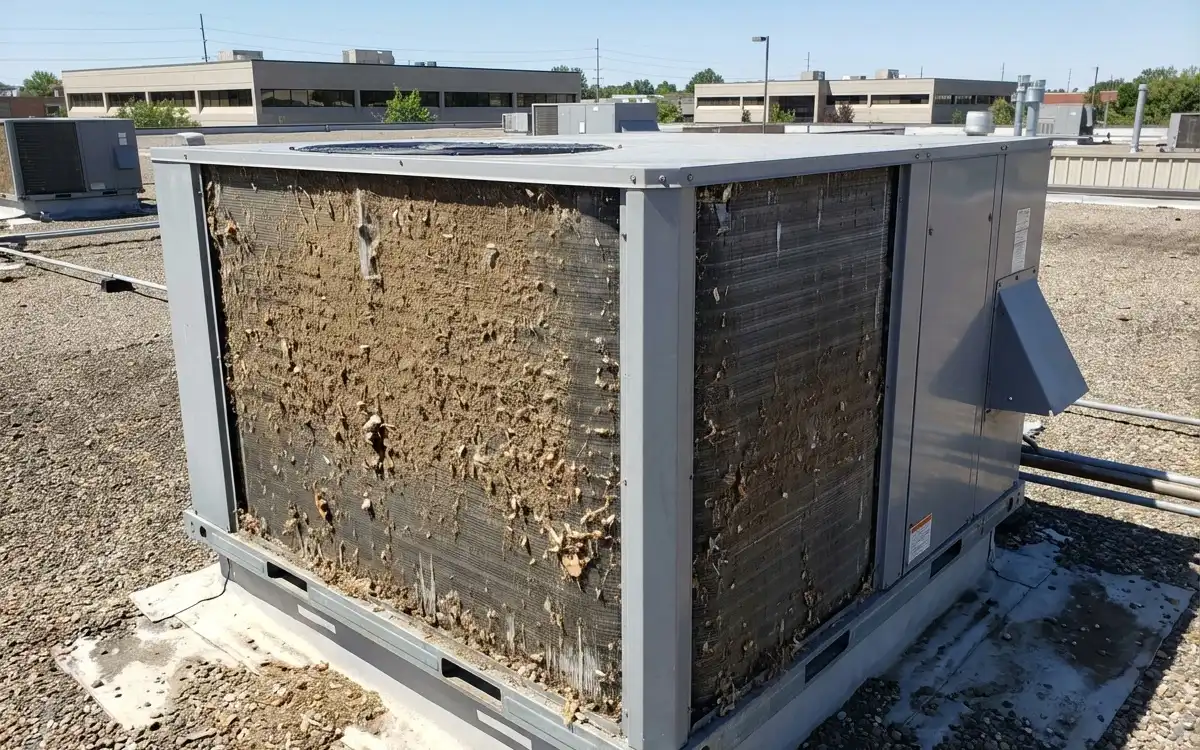
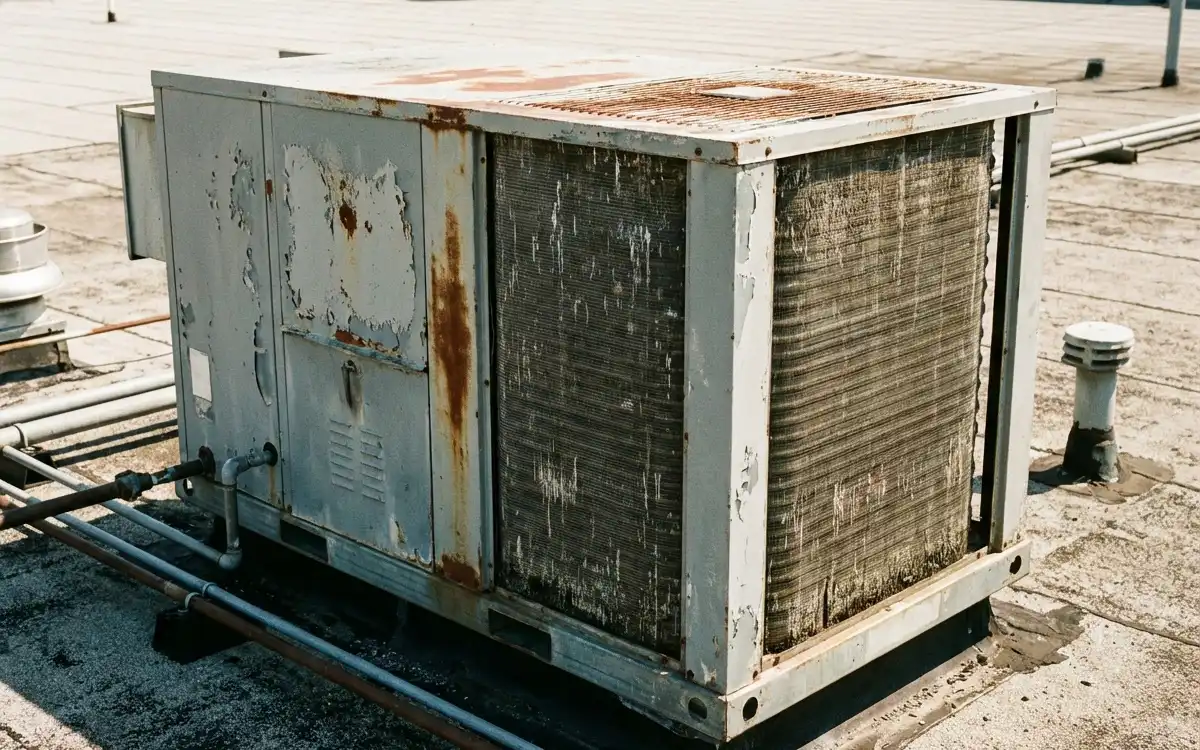
Commercial condenser and evaporator coils gradually collect dirt, pollen, grease, cottonwood, construction debris, and airborne contaminants. As this buildup increases, the coil becomes less efficient at transferring heat.
Even a relatively thin layer of contamination can force the system to work significantly harder.
Dirty condenser coils commonly cause elevated head pressure during hot Indiana summers, while dirty evaporator coils reduce airflow and contribute to freezing conditions that interrupt normal operation.
Facilities especially susceptible to dirty coils include:
- Restaurants
- Manufacturing facilities
- Warehouses
- Buildings near construction sites
- Facilities surrounded by trees or cottonwood
- Industrial operations with airborne contaminants
Coil contamination not only increases the likelihood of short cycling but also reduces cooling capacity and increases operating costs.
Routine preventative maintenance helps identify these issues before they trigger nuisance shutdowns or expensive compressor failures.
3. Sensor, Thermostat, and Building Control Problems
Not every short cycling problem originates inside the HVAC equipment itself. Modern commercial buildings rely on thermostats, sensors, building automation systems (BAS), and sophisticated control sequences to determine when equipment should start, stop, or change capacity. If any of those inputs become inaccurate, the equipment may respond exactly as programmed, even though it is operating at the wrong time.
A single temperature sensor that has drifted only a few degrees out of calibration can create a chain reaction throughout the system. The rooftop unit may repeatedly satisfy a false temperature reading while large portions of the building remain uncomfortable.
Common control-related issues include:
- Temperature sensors that have drifted out of calibration
- Thermostats installed near supply diffusers or exterior doors
- Direct sunlight affecting thermostat readings
- Loose low-voltage wiring
- Faulty relays or control boards
- Improper deadband settings
- Conflicting building automation schedules
- Communication failures between BAS components
- Incorrect staging sequences
“Today’s commercial HVAC systems are incredibly intelligent, but they’re only as accurate as the information they receive. We’ve solved many ‘equipment problems’ that ultimately turned out to be a faulty sensor or a programming issue.” — The Choice Mechanical Team
Buildings with advanced automation systems can be especially difficult to troubleshoot because the equipment may be responding correctly to an incorrect command. A technician must determine whether the shutdown originated from a mechanical problem, a safety device, or a control sequence.
| Control Problem | Potential Result |
|---|---|
| Faulty Room Sensor | Premature equipment shutdown |
| Poor Thermostat Location | False temperature readings |
| Incorrect BAS Schedule | Unexpected starts and stops |
| Communication Failure | Erratic equipment operation |
| Improper Deadband | Frequent cycling between heating and cooling |
4. Refrigerant-Side Problems
The refrigeration circuit is another common source of short cycling. Compressors are protected by pressure and temperature safety controls designed to prevent damage when operating conditions move outside acceptable limits.
If refrigerant pressures become too high or too low, the compressor may shut down until conditions stabilize, only to restart a few minutes later and repeat the same cycle.
Potential refrigeration-related causes include:
- Incorrect refrigerant charge
- Refrigerant leaks
- Restricted metering devices
- Blocked filter driers
- Poor condenser airflow
- Dirty condenser coils
- Failed condenser fans
- Refrigerant restrictions
- Compressor performance issues
One of the most common misconceptions is that every short cycling system must be low on refrigerant. While refrigerant issues certainly can contribute, they represent only one possible cause among many.
“We never assume a refrigerant problem based on short cycling alone. Pressure readings, temperatures, airflow, and operating conditions all have to tell the same story before adding refrigerant is ever considered.” — The Choice Mechanical Team
Simply adding refrigerant without locating the underlying issue may temporarily change system behavior while leaving the real problem unresolved. In some situations, it can actually create additional reliability problems.
| Refrigeration Issue | Possible Result |
|---|---|
| Low Refrigerant Charge | Low-pressure safety trips |
| Dirty Condenser Coil | High-pressure shutdowns |
| Failed Condenser Fan | Elevated head pressure |
| Restricted Metering Device | Unstable refrigerant flow |
| Refrigerant Restriction | Repeated compressor cycling |
5. Electrical Problems and Safety Controls
Commercial HVAC equipment includes numerous safety devices that continuously monitor operating conditions. These controls are designed to protect expensive equipment from overheating, excessive pressure, electrical faults, and unsafe operating conditions.
When one of these safeties opens, the equipment often shuts down immediately. Once conditions normalize, the system may restart, creating what appears to be short cycling.
Electrical and safety-related causes may include:
- Loose electrical connections
- Failing contactors
- Weak relays
- Pressure switches
- High-temperature limit controls
- Condensate overflow switches
- Motor overload protection
- Faulty flame sensors
- Power quality issues
These safety devices should never be viewed as the problem themselves. They are doing exactly what they were designed to do by protecting equipment from abnormal operating conditions.
“Safety controls rarely fail without a reason. More often, they’re responding to another problem somewhere else in the system. Resetting the unit over and over doesn’t solve what’s causing the shutdown.” — The Choice Mechanical Team
If breakers continue tripping, pressure switches repeatedly open, or safety devices continue locking out equipment, the underlying cause should be professionally diagnosed before additional damage occurs.
6. Oversized Equipment
Not every short cycling problem is caused by a mechanical failure. Sometimes the equipment simply has more capacity than the building currently requires.
An oversized rooftop unit or split system may satisfy the thermostat very quickly, shutting down before conditioned air has been evenly distributed throughout the building or before sufficient humidity has been removed.
Oversizing can occur because:
- Equipment was selected using existing nameplate size instead of a load calculation
- Building renovations reduced heating or cooling demand
- Lighting upgrades lowered internal heat gain
- Occupancy changed significantly
- Manufacturing or process loads were reduced
- Building envelope improvements increased efficiency
Oversized equipment can produce comfortable temperatures near the thermostat while leaving distant offices, conference rooms, or production areas uncomfortable.
| Oversized Equipment Can Cause | Operational Impact |
|---|---|
| Short Runtime | Frequent equipment starts |
| Poor Humidity Removal | Sticky indoor conditions |
| Uneven Temperatures | Hot and cold spots |
| Higher Wear | More compressor and motor starts |
| Lower Efficiency | Higher operating costs |
Fortunately, replacement is not always the first recommendation. Depending on the equipment, technicians may be able to improve staging, airflow, zoning, or control sequences before considering equipment replacement.
7. Zoning, VAV Systems, and Building Pressure Problems
Commercial HVAC systems operate as complete building systems, not as individual pieces of equipment. Problems elsewhere in the air distribution system can easily create symptoms that appear to originate at the rooftop unit.
Variable air volume (VAV) boxes, duct pressure controls, economizers, make-up air units, exhaust systems, and building pressurization all influence how central HVAC equipment performs.
For example, if numerous VAV boxes close simultaneously, airflow through the rooftop unit may drop below acceptable levels. Likewise, poorly coordinated exhaust and make-up air systems can dramatically alter building pressure and cooling demand.
Potential contributing issues include:
- Too many VAV boxes closed simultaneously
- Faulty bypass dampers
- Incorrect duct static pressure settings
- Economizer control problems
- Building pressure imbalances
- Exhaust systems operating outside design conditions
- Improper make-up air operation
“Sometimes the rooftop unit isn’t actually the problem. We’ve diagnosed buildings where the equipment kept shutting down because another part of the HVAC system was creating conditions it was never designed to operate under.” — The Choice Mechanical Team
Because of these interactions, experienced commercial HVAC technicians evaluate the entire HVAC system rather than focusing exclusively on the equipment that’s cycling.
8. Rapid Load Changes Throughout the Building
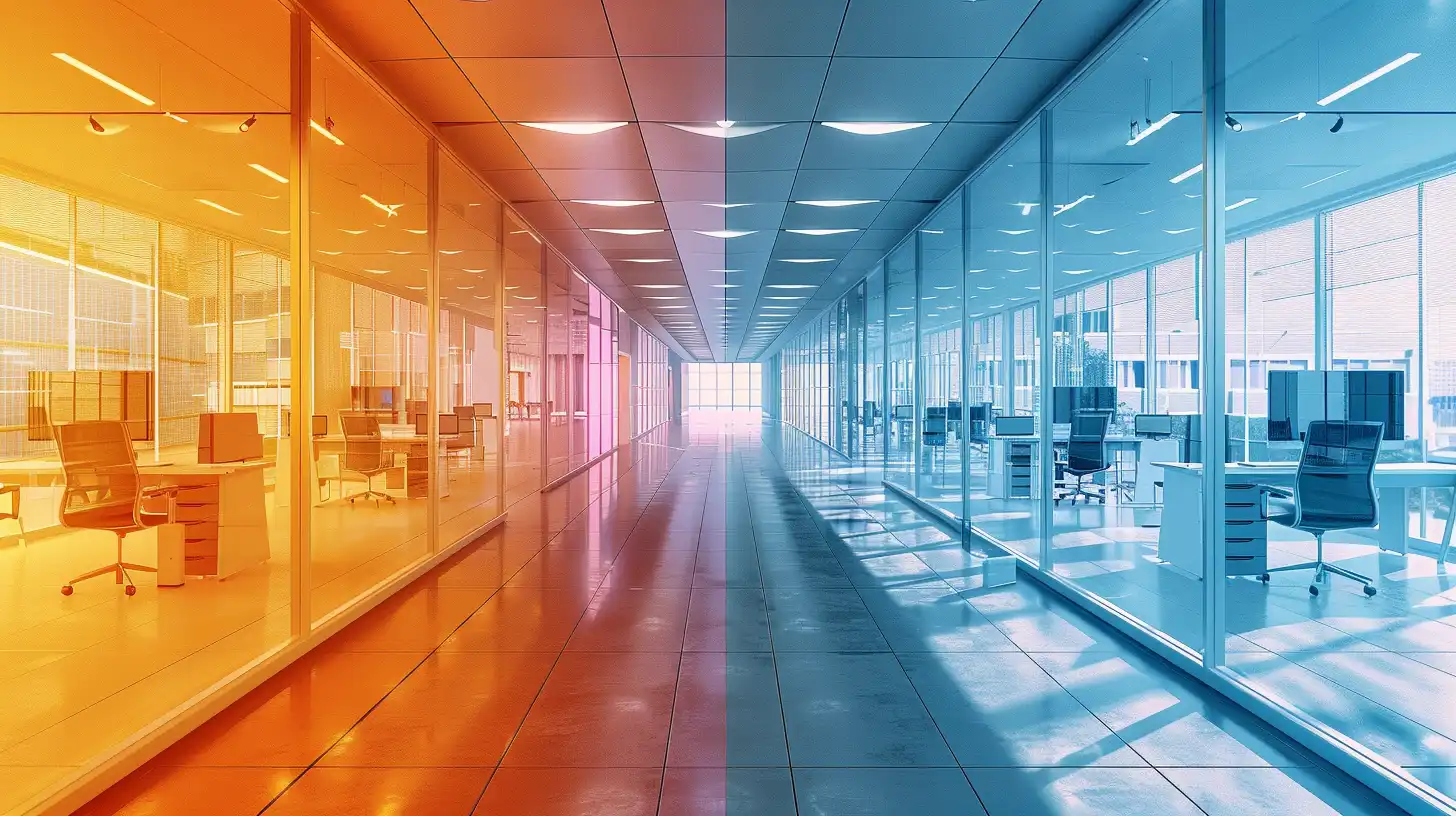
Not every increase in cycling is caused by faulty equipment. Commercial buildings experience changing loads throughout the day that naturally affect HVAC operation.
Morning warm-up, occupied versus unoccupied schedules, warehouse loading docks, commercial kitchens, conference rooms, production equipment, and changing weather conditions all influence how often HVAC equipment operates.
If cycling consistently occurs during specific times of day, technicians often review trend data and BAS history to determine whether changing building loads are contributing to the behavior.
Examples include:
- Morning occupancy startup
- Night setback recovery
- Large conference room occupancy
- Loading dock doors opening frequently
- Commercial kitchen exhaust systems
- Manufacturing process equipment
- Rapid weather changes
Understanding when short cycling occurs can be just as valuable as understanding how often it occurs. Trend data frequently provides the clues needed to separate a controls issue from a true mechanical problem.
What Facility Teams Can Check Safely Before Calling for Service
While diagnosing the root cause of short cycling requires specialized training and diagnostic equipment, facility managers and maintenance teams can gather valuable information before a technician arrives. These observations often reduce troubleshooting time and help identify patterns that may not be apparent during a single service visit.
Rather than repeatedly resetting the equipment, document exactly what the system is doing.
Helpful information includes:
- How long the equipment runs before shutting off
- How long it remains off before restarting
- Which rooftop unit, air handler, or compressor stage is affected
- Whether the issue occurs in heating, cooling, or ventilation mode
- Outdoor temperature and weather conditions
- Building occupancy at the time
- Building automation alarms or fault codes
- Recent maintenance or repairs
- Recent thermostat or BAS programming changes
“The more information we have before arriving on-site, the faster we can narrow down the possible causes. A few good observations from the facility staff often save hours of diagnostic work.” — The Choice Mechanical Team
If facility procedures allow, maintenance personnel can also perform a basic visual inspection.
- Check accessible air filters for excessive dirt.
- Verify that supply and return grilles are not blocked.
- Listen for unusual noises from rooftop units or mechanical rooms.
- Look for obvious water around condensate drains.
- Review BAS alarms and recent trend history.
However, commercial HVAC equipment should never be disassembled or reset repeatedly by unqualified personnel.
Do not:
- Open energized electrical panels
- Bypass safety controls
- Add refrigerant
- Reset lockouts repeatedly
- Remove protective covers
- Work on rooftop equipment without proper training and fall protection
Commercial HVAC systems contain high voltage, rotating equipment, pressurized refrigerant, combustion components, and rooftop hazards that require trained technicians.
How Commercial HVAC Technicians Diagnose Short Cycling
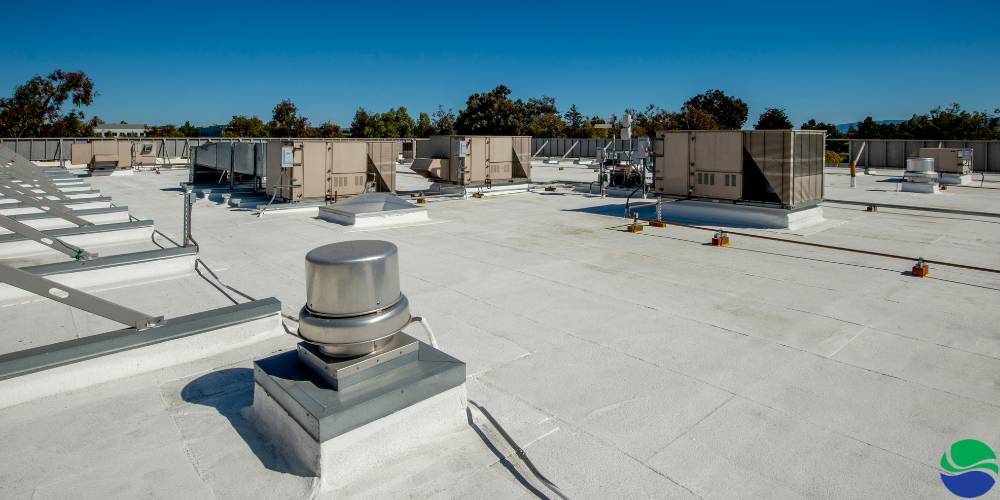
Because dozens of different issues can produce nearly identical symptoms, experienced technicians begin by identifying what is actually ending the operating cycle.
Is the thermostat satisfied?
Did a safety control open?
Did the building automation system command the shutdown?
Did the compressor reach a pressure limit?
Answering those questions usually leads technicians toward the actual problem instead of simply replacing parts based on assumptions.
A comprehensive commercial HVAC diagnostic may include:
- Reviewing alarm history and BAS trend logs
- Verifying the equipment’s sequence of operation
- Measuring supply and return air temperatures
- Checking total external static pressure
- Measuring airflow
- Inspecting evaporator and condenser coils
- Evaluating blower motors and belts
- Testing electrical connections and contactors
- Checking sensors and thermostat calibration
- Evaluating refrigerant operating conditions
- Testing economizer operation
- Reviewing VAV box operation when applicable
“Good diagnostics eliminate guesswork. Instead of replacing the component that looks suspicious, we verify what’s ending the cycle and work backward from there. That’s how recurring service calls are prevented.” — The Choice Mechanical Team
In many facilities, the problem extends beyond the rooftop unit itself. Building automation systems, zoning controls, economizers, exhaust systems, occupancy schedules, and even recent renovations may all contribute to unstable HVAC operation.
How Different Commercial Buildings Experience Short Cycling
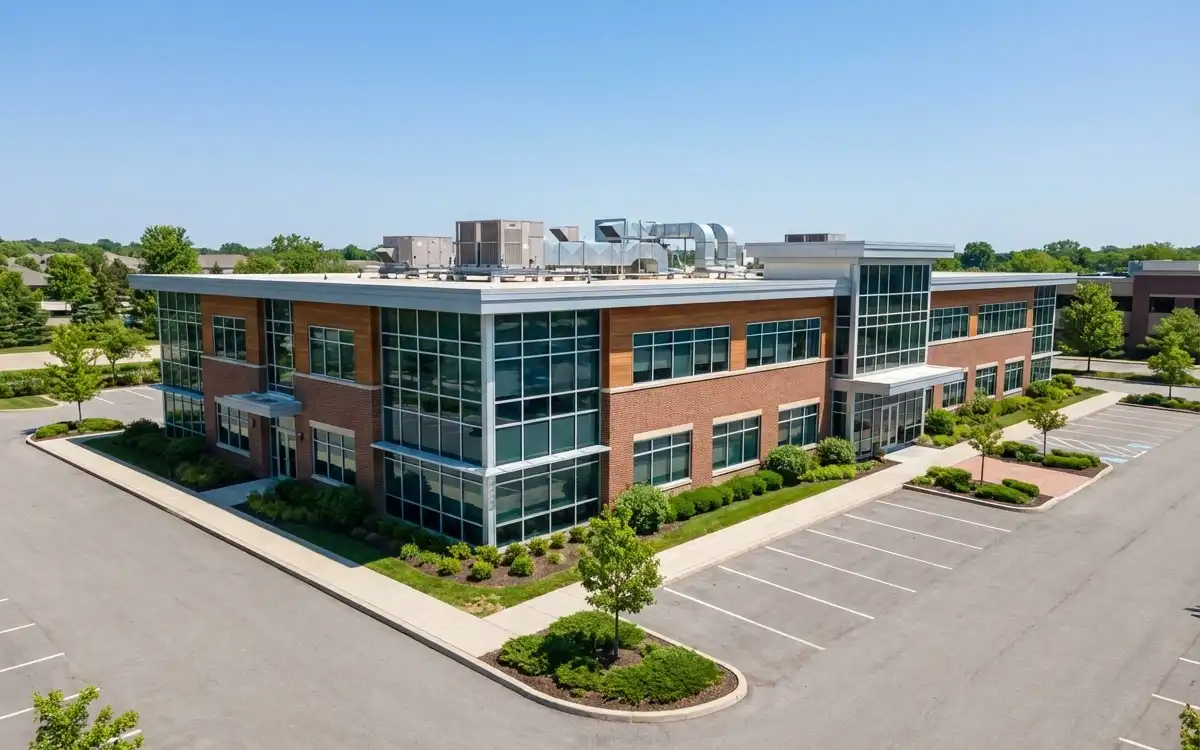
Short cycling doesn’t affect every facility the same way. The impact often depends on how the building is used and how critical temperature control is to daily operations.
Office Buildings
Office buildings often experience frequent occupant comfort complaints when HVAC equipment short cycles. Employees may notice hot and cold spots, conference rooms that never reach comfortable temperatures, or humidity that makes the building feel warmer than the thermostat indicates.
Warehouses and Distribution Centers
Large warehouse facilities depend on consistent airflow across expansive spaces. Short cycling can leave loading docks, storage areas, and upper rack levels significantly warmer than occupied workspaces. Inventory protection may also become a concern when temperatures fluctuate.
Restaurants and Commercial Kitchens
Restaurants create rapidly changing cooling loads because of cooking equipment, exhaust systems, and customer traffic. Short cycling can increase dining room discomfort while making kitchen environments even more difficult for employees.
Manufacturing Facilities
Manufacturing plants often generate substantial internal heat from machinery and production equipment. HVAC instability can affect employee comfort, equipment reliability, and, in some industries, production quality.
Healthcare Facilities
Hospitals, clinics, and medical offices frequently maintain tighter environmental requirements than standard commercial buildings. Reliable HVAC operation is essential for patient comfort, equipment protection, and proper indoor environmental conditions.
“Every facility has different priorities. For one customer, it’s employee comfort. For another, it’s protecting production equipment or maintaining proper environmental conditions. That’s why we always diagnose short cycling within the context of how the building actually operates.” — The Choice Mechanical Team
When Is Commercial HVAC Short Cycling an Emergency?
Not every short cycling event requires an emergency service call. However, some conditions indicate a potentially serious equipment or safety issue that should be addressed immediately.
Contact a qualified commercial HVAC contractor promptly if you observe:
- Smoke or burning odors
- Electrical arcing
- Repeated breaker trips
- Severe equipment vibration
- Water leaking near electrical components
- Signs of overheating
- Repeated compressor lockouts
- Combustion-related concerns
- Critical spaces losing temperature control
Emergency response is especially important when HVAC failures threaten:
- Healthcare operations
- Food safety
- Server rooms
- Temperature-sensitive inventory
- Freeze protection
- Manufacturing processes
- Business continuity
Waiting until equipment completely fails often results in longer downtime, more extensive repairs, and greater disruption to facility operations.
“A system that’s repeatedly shutting itself down is usually trying to protect itself. Addressing the problem while it’s still operating is almost always less expensive than waiting until it stops completely.” — The Choice Mechanical Team
How Preventative Maintenance Helps Prevent Short Cycling
Not every equipment failure can be predicted, but many of the conditions that lead to short cycling develop gradually over time. Dirt accumulates on coils, filters become restricted, electrical connections loosen, sensors drift out of calibration, belts wear, and controls gradually fall out of adjustment.
Routine preventative maintenance allows technicians to identify these issues before they begin affecting system performance.
A comprehensive commercial HVAC maintenance visit may include:
- Replacing or inspecting air filters
- Cleaning evaporator and condenser coils
- Inspecting blower motors, belts, and bearings
- Checking electrical connections and contactors
- Testing sensors and thermostat calibration
- Reviewing building automation system operation
- Verifying economizer performance
- Inspecting condensate drains and safety switches
- Monitoring refrigerant operating conditions
- Documenting equipment performance for future comparison
Preventative maintenance is especially valuable because many short cycling problems begin long before occupants notice comfort issues. By the time employees start reporting hot and cold spots or rising humidity, the equipment may have been operating inefficiently for weeks or even months.
“Our goal isn’t simply to repair equipment after it fails. We want to identify the small problems that eventually become emergency service calls. That’s where preventative maintenance provides the greatest value.” — The Choice Mechanical Team
Facilities with multiple rooftop units also benefit from trend tracking over time. Documenting recurring alarms, operating pressures, airflow measurements, and equipment history helps technicians identify developing issues before they become major failures.
Temporary Fixes vs. Finding the Root Cause
One of the biggest mistakes facilities make is treating short cycling as an isolated event instead of a symptom. Resetting the equipment may temporarily restore operation, but it rarely addresses the condition that caused the shutdown.
| Temporary Fix | Long-Term Solution |
|---|---|
| Replacing a filter without checking airflow | Measure airflow and identify all restrictions |
| Resetting a safety lockout | Determine why the safety opened |
| Adding refrigerant without testing the system | Diagnose refrigerant conditions and locate the underlying issue |
| Replacing parts based on assumptions | Verify the actual cause through systematic diagnostics |
| Ignoring intermittent cycling | Document patterns before they become equipment failures |
Taking the time to properly diagnose short cycling often prevents unnecessary repairs while improving overall system reliability.
Frequently Asked Questions About Commercial HVAC Short Cycling
Can a dirty air filter cause commercial HVAC short cycling?
Yes. A heavily loaded air filter can restrict airflow enough to create abnormal operating temperatures that trigger safety controls. However, filters are only one possible airflow restriction. Dirty coils, failing blower motors, closed dampers, and duct restrictions can create similar symptoms.
Is short cycling always caused by low refrigerant?
No. While refrigerant issues can contribute to short cycling, airflow restrictions, faulty sensors, electrical problems, safety devices, building automation controls, zoning issues, and oversized equipment are all common causes. Refrigerant conditions should always be tested rather than assumed.
Can oversized HVAC equipment be corrected without replacing it?
Sometimes. Depending on the equipment and the building, technicians may improve staging, airflow, zoning, fan operation, or control sequences to reduce cycling. In some cases, however, replacement may be the most dependable long-term solution.
Should we keep resetting equipment that keeps shutting down?
No. Repeated resets may temporarily restore operation while allowing the underlying problem to become worse. Safety controls are designed to protect equipment, and repeatedly bypassing or resetting them can lead to more extensive damage.
How quickly should short cycling be investigated?
As soon as practical. Even if the building remains comfortable, recurring short cycling increases equipment wear and energy consumption. Early diagnosis often prevents larger repairs and unexpected downtime.
Can short cycling increase utility costs?
Yes. Startup is one of the least efficient parts of HVAC operation. Systems that repeatedly start and stop often consume more energy than equipment operating through normal heating or cooling cycles.
How long should a commercial rooftop unit normally run?
There is no universal runtime. Normal operation depends on equipment design, outdoor conditions, occupancy, building load, staging strategy, and building automation sequences. What matters most is whether the equipment is completing efficient operating cycles rather than shutting down prematurely.
What industries are affected most by HVAC short cycling?
Any commercial facility can experience short cycling, but warehouses, manufacturing plants, healthcare facilities, restaurants, retail centers, schools, office buildings, and facilities with critical temperature requirements are often affected most because of the impact on operations and occupant comfort.
Commercial HVAC Short Cycling Diagnosis in Indianapolis and Central Indiana
Commercial HVAC short cycling is rarely a problem that fixes itself. Whether the issue stems from airflow restrictions, dirty coils, faulty controls, refrigeration problems, electrical faults, or building automation sequences, identifying the root cause early helps prevent unnecessary downtime and expensive repairs.
Choice Mechanical Services provides commercial HVAC diagnostics, repair, installation, and preventative maintenance for businesses throughout Indianapolis and Central Indiana.
Our technicians service a wide range of commercial HVAC equipment, including:
- Commercial rooftop units (RTUs)
- Split systems
- Air handling units
- Heat pumps
- Packaged equipment
- Boilers
- Chillers
- Commercial refrigeration systems
- Building automation and controls
We proudly serve commercial facilities throughout Indianapolis, Carmel, Fishers, Greenwood, Plainfield, Avon, Brownsburg, Noblesville, Lawrence, and surrounding Central Indiana communities.
Don’t Ignore the Warning Signs
Short cycling is one of the clearest indicators that an HVAC system is operating outside normal conditions. While the equipment may continue running for days, weeks, or even months, every unnecessary start places additional stress on compressors, motors, electrical components, and control systems.
The sooner the underlying issue is identified, the more likely it can be corrected before it leads to an emergency shutdown or major equipment failure.
“Every HVAC system tells a story through the way it operates. Short cycling is one of the clearest signs that something isn’t right. Diagnosing it early almost always costs less than repairing the damage after a failure.” — The Choice Mechanical Team
If your commercial HVAC equipment is repeatedly starting and stopping, experiencing frequent lockouts, or struggling to maintain comfortable temperatures, don’t wait until a minor issue becomes a costly disruption.
Contact Choice Mechanical Services today or call (317) 885-0200 to schedule commercial HVAC diagnostics anywhere in Indianapolis or Central Indiana.
Our experienced technicians can identify the root cause of short cycling, recommend practical solutions, and help keep your commercial HVAC system operating efficiently throughout the year.