A building can be at the thermostat setpoint and still feel wrong. Paper curls. Metal diffusers sweat. Exterior walls develop damp spots. Employees describe the space as clammy, while a server room reports static-related concerns during winter. These are not contradictory complaints; they show that temperature alone does not describe the moisture condition of a commercial building.
Commercial humidity control requires the HVAC system, ventilation strategy, building envelope, exhaust systems, and controls to work together. Cooling equipment can remove moisture, but only when airflow, coil temperature, runtime, and drainage support dehumidification. Heating may lower relative humidity without removing any water from the air. Outdoor air can either dry a building or add a large latent load depending on the season.
Relative Humidity Is Useful. Dew Point Explains Condensation
Relative humidity describes how close air is to saturation at its current temperature. Because warmer air can hold more water vapor, relative humidity changes when temperature changes even if the actual amount of moisture does not.
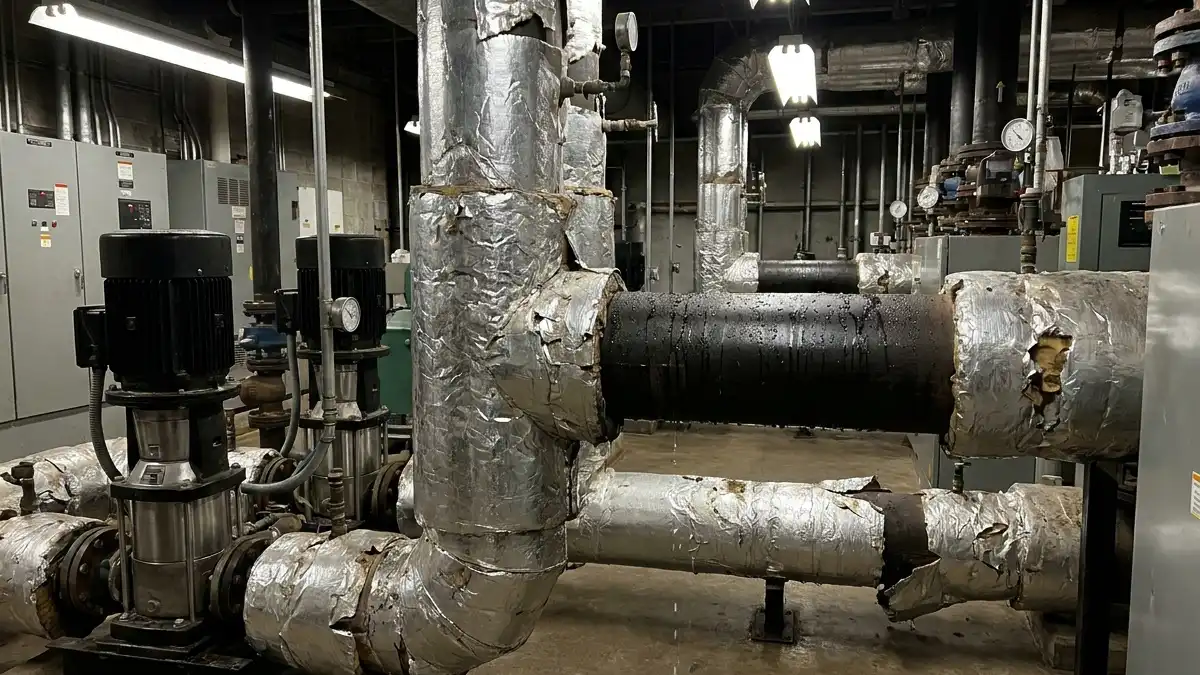
Dew point is the temperature at which moisture begins to condense from the air. If a chilled-water pipe, supply diffuser, wall cavity, or cold storage surface falls below the surrounding air’s dew point, condensation can form. That makes dew point especially useful when diagnosing sweating surfaces and moisture migration.
“When a diffuser sweats, wiping the water is not the diagnosis. We compare the surface temperature with the room dew point and then find out why those conditions met.”
What Excess Humidity Can Do to a Commercial Facility
| Area affected | Possible moisture consequence | Questions to investigate |
|---|---|---|
| Occupied offices | Clammy comfort, odors, condensation, material swelling | Is outdoor air controlled? Does cooling run long enough to remove moisture? |
| Medical space | Loss of required environmental conditions or pressure relationships | Are room requirements defined? Are sensors and alarms validated? |
| Food or production area | Condensation, process instability, sanitation concerns | Are exhaust and make-up air balanced? Does the process add moisture? |
| Warehouse | Packaging damage, corrosion, sweating product or floors | Do open docks and infiltration drive the moisture load? |
| Mechanical and ceiling spaces | Wet insulation, corrosion, stained ceilings, concealed moisture | Are cold surfaces insulated and vapor sealed? Is humid air entering the space? |
The appropriate humidity range is not identical for every facility. Comfort guidance, process requirements, infection-control needs, product specifications, equipment limits, and the building envelope may impose different targets. A setpoint should be selected intentionally rather than copied from an unrelated building.
Why Humidity Problems Often Appear in Mild Weather
On a hot Indianapolis afternoon, cooling equipment may run long enough to remove substantial moisture. During a mild but humid day, the sensible cooling load can fall while outdoor-air moisture remains high. The thermostat is satisfied quickly, compressor runtime decreases, and dehumidification can become inadequate.
This shoulder-season pattern is common in buildings with oversized equipment, high ventilation loads, intermittent occupancy, or controls that focus only on dry-bulb temperature. Lowering the thermostat may increase cooling and risk overcooling without providing a stable long-term solution.
Seven Sources of Commercial Humidity Trouble
1. Outdoor Air Is Not Measured or Controlled Correctly
A stuck outdoor-air damper, failed actuator, incorrect minimum position, or economizer sequence can admit more humid air than intended. Conversely, closing outdoor air to hide a moisture problem can compromise ventilation requirements. Damper position, airflow, and control commands need to be verified rather than inferred from a screen graphic.
2. Building Pressure Pulls Moisture Through the Envelope
When exhaust exceeds supplied and transferred air, a building may operate under negative pressure. Humid outdoor air then enters through doors, cracks, wall assemblies, and other uncontrolled paths. Kitchens, labs, restrooms, and production exhaust can change pressure dramatically if make-up air is unavailable or poorly coordinated.
3. Cooling Equipment Is Oversized for the Current Load
An oversized unit may satisfy temperature rapidly and shut off before the coil operates long enough to remove sufficient moisture. Building envelope upgrades, lower lighting loads, occupancy changes, and like-for-like replacement based on an old nameplate can all contribute to a mismatch. A current RTU repair, recommissioning, or replacement assessment should consider both sensible and latent performance.
4. Airflow Is Too High or Too Low
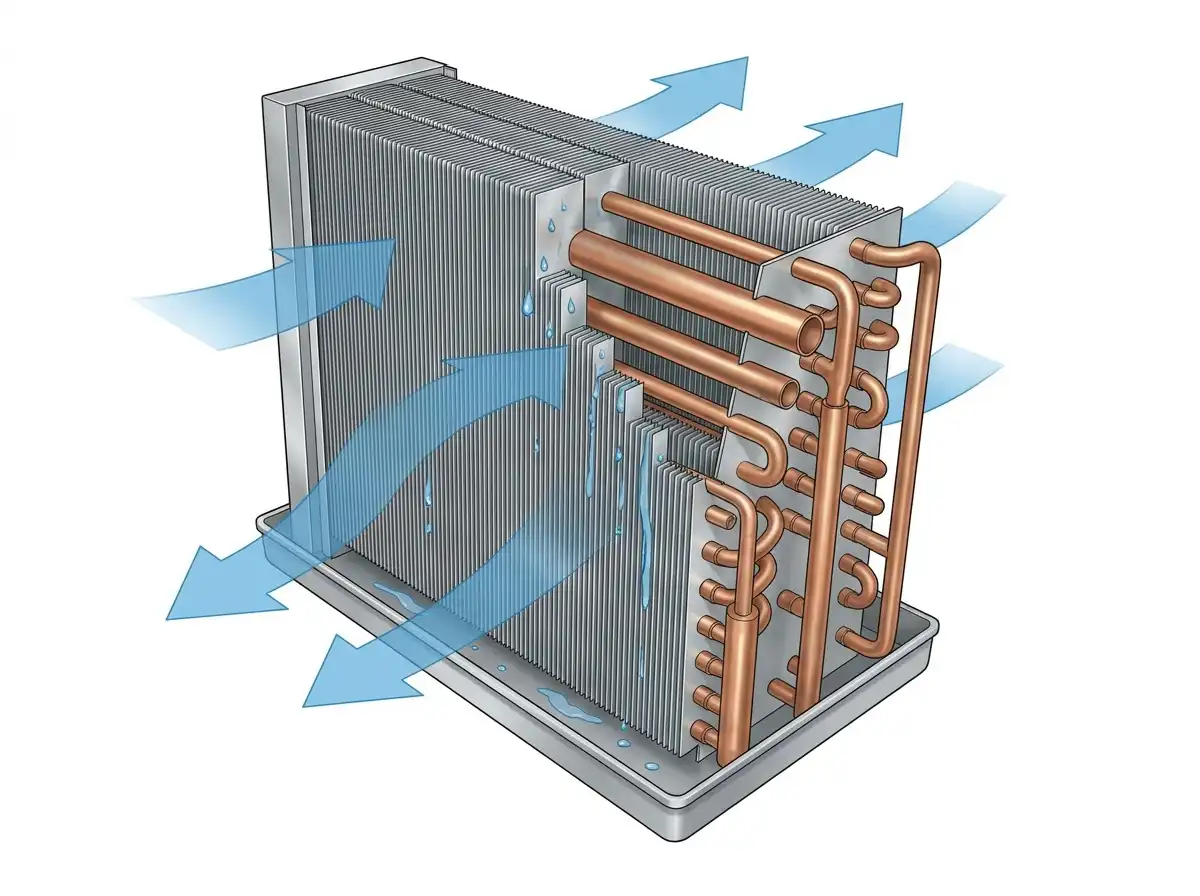
Airflow across a cooling coil affects its surface temperature and moisture-removal performance. Excess airflow can reduce dehumidification; inadequate airflow can contribute to icing and poor capacity. Fan speed should not be adjusted solely to chase humidity without confirming coil, refrigerant, filtration, and distribution conditions.
5. Reheat or Dehumidification Control Is Not Coordinated
Some facilities require cooling below the space temperature needed for moisture removal, followed by reheat to avoid overcooling. If sensors, valves, staging, or sequences fail, the system may alternate between cold and humid or warm and humid. Reheat strategies must also be evaluated for energy performance and applicable requirements.
6. Sensors Misrepresent the Space
A humidity sensor near a supply diffuser, exterior door, moisture source, or warm wall may not represent the occupied zone. Sensors can drift, respond slowly, or disagree with the building automation system. Comparison with a calibrated instrument is a basic diagnostic step.
7. Drainage, Insulation, or Envelope Problems Create Local Moisture
A blocked condensate drain, failed trap, wet insulation, roof leak, unsealed vapor barrier, or cold bridge can create localized moisture that looks like a whole-building humidity problem. The location and timing of condensation help distinguish a source problem from a control problem.
A Medical-Office Scenario in Indianapolis
Imagine an outpatient facility where exam rooms feel comfortable but ceiling diffusers begin sweating on humid mornings. The building automation system reports acceptable room relative humidity by afternoon, so the complaint appears intermittent.
Investigation should not begin by changing every thermostat. A technician can trend outdoor dew point, room dew point, discharge-air temperature, unit status, and outdoor-air damper command. The team can inspect diffuser insulation, verify actual ventilation airflow, evaluate building pressure, and compare installed sensor readings with calibrated measurements.
The result may reveal more than one contributor—for example, excess outdoor air during morning start-up and damaged insulation at the affected diffusers. Correcting only one would leave the other condition in place. Choice Mechanical works with medical buildings in Indianapolis and Central Indiana where temperature, humidity, airflow, and reliability must be evaluated together.
Build a Humidity Trend That Can Be Diagnosed
A single handheld reading is a snapshot. Moisture problems are easier to understand when data covers different weather, occupancy, and operating modes. Useful trend points may include:
- Outdoor temperature and dew point
- Representative space temperature and relative humidity
- Supply or discharge-air temperature
- Cooling, reheat, and fan status
- Outdoor-air damper command and verified position
- Building or room differential pressure where applicable
- Exhaust and make-up air status
- Condensate alarms or drain-pan conditions
Trend intervals should be short enough to reveal cycling without creating unusable data. Sensor accuracy and timestamps should be checked before conclusions are drawn.
What Facility Teams Should Do When Condensation Appears
Protect people, products, and electrical equipment first. Mark wet areas, address slip hazards, and follow site procedures for water near energized components. Photograph the location and record weather, time, equipment status, and whether the moisture returns after cleaning.
Do not cover a wet surface, close ventilation dampers indiscriminately, or lower the thermostat repeatedly. Those steps can conceal the evidence, compromise ventilation, or make condensation worse. Persistent moisture inside walls, ceilings, insulation, or occupied materials may require coordinated mechanical and building-envelope assessment.
“Humidity control is a load problem and a control problem. We need to know where the moisture comes from, how it enters, and which operating mode is supposed to remove it.”
Commercial Humidity Control FAQs
Will running the air conditioner colder reduce humidity?
It may remove more moisture temporarily, but it can overcool the building and does not correct oversizing, excess outdoor air, pressure imbalance, sensor error, or a failed dehumidification sequence.
Why do supply diffusers sweat?
Condensation forms when the diffuser surface is below the surrounding air’s dew point. High room dew point, very cold supply air, missing insulation, air leakage around the boot, or a combination may be responsible.
Can negative building pressure raise indoor humidity?
Yes. Negative pressure can draw humid outdoor air through uncontrolled openings. The impact depends on weather, envelope leakage, exhaust, supplied outdoor air, and space relationships.
How often should humidity sensors be checked?
The interval depends on sensor quality, application criticality, manufacturer guidance, and observed drift. Critical spaces generally need more formal calibration and documentation than ordinary comfort zones.
Does Choice Mechanical provide preventative humidity-control service?
Choice Mechanical offers custom commercial maintenance agreements that can include controls, filters, coils, drainage, ventilation, and operating review based on the facility’s equipment and risk.
Control Moisture Before It Reaches the Building Materials
Commercial humidity control is most reliable when outdoor air, exhaust, building pressure, cooling, airflow, reheat, sensors, drainage, insulation, and the envelope are treated as one moisture-management system.
If your Indianapolis or Central Indiana facility has persistent condensation, humidity alarms, clammy spaces, or unexplained moisture damage, call Choice Mechanical at (317) 885-0200 or request an HVAC service evaluation. Bring several days of temperature and humidity history if available; the pattern is often more valuable than a single reading.