Why HVAC Downtime Is a Big Risk in Warehouses and Distribution Centers
When the HVAC system in a warehouse or distribution center goes down, the problem reaches far beyond temperature. In Indiana facilities, downtime can disrupt throughput, damage inventory, create unsafe working conditions, and expose the business to compliance risk. In some operations, HVAC is a comfort system. In others, it is part of the product-quality system. That distinction matters.
Warehouses are not all the same. A general merchandise distribution center may feel the pain first through labor slowdown and delayed outbound flow. A food, pharmaceutical, or refrigerated warehouse may face product loss, quarantine decisions, or regulatory exposure within hours. That is why warehouse HVAC downtime should be treated as a serious operational risk, not just a maintenance inconvenience.
Need emergency support right now? Choice Mechanical offers 24/7 commercial HVAC emergency services for warehouses and distribution centers throughout Indianapolis and Central Indiana.
Want to reduce the chances of a surprise failure later? Our article on The Cost of Skipping Maintenance on Commercial HVAC Systems is a strong companion piece to this guide.
1. Downtime Disrupts Operations Faster Than Most Teams Expect
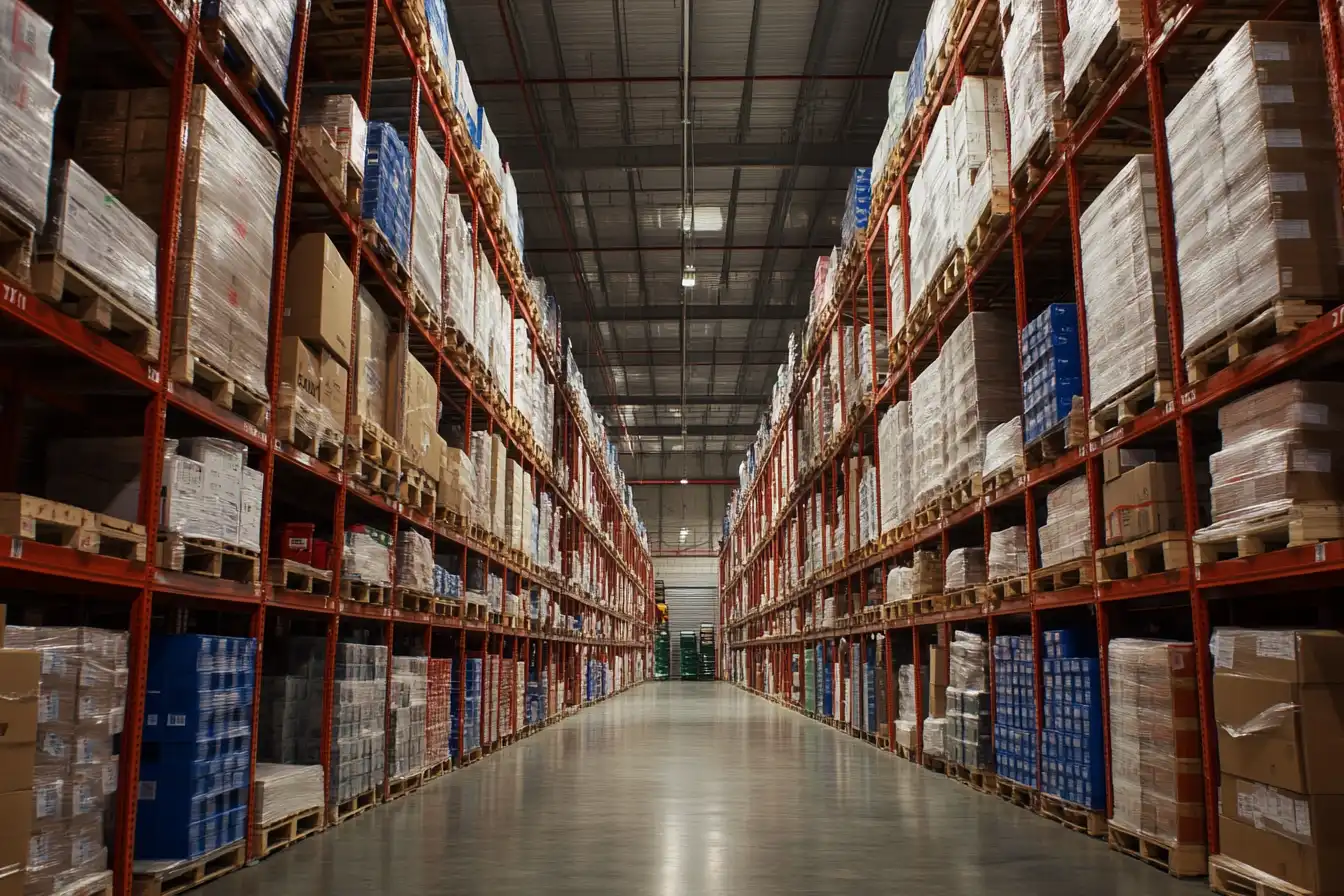
In busy Indiana warehouses, HVAC downtime rarely stays isolated to one issue. Once temperature, humidity, or ventilation start drifting, the effects spread quickly through the building. Equipment performance, labor efficiency, packaging integrity, and shipping flow can all take a hit at the same time.
- Excessive heat can reduce worker productivity and increase fatigue during physically demanding tasks
- High humidity can affect packaging, labeling, and material handling
- Cold indoor conditions can impact worker comfort and equipment performance in certain zones
- Power loss or control failure can knock out HVAC, alarms, and visibility at the same time
That last point matters more than many teams realize. In warehouse settings, downtime often becomes a multi-system event. Temperature drift affects product. Humidity drift affects packaging and condensation. Lost ventilation affects worker safety. Open dock doors used as a workaround can make all of it worse.
Let’s build an HVAC risk strategy before the next outage forces you into reaction mode.
2. The Most Expensive HVAC Failures Are Not Always the Most Common
Many warehouse managers assume the biggest risk is simply how often equipment breaks. Frequency matters, but severity matters more. In refrigeration-related loss data, mechanical and electrical failures happen often, but contamination and temperature-change events drive a much larger share of the actual financial loss.
- Routine mechanical breakdowns may be more common, but they are not always the costliest
- Temperature excursions and contamination events can trigger inventory loss, sanitation response, and compliance action
- A small number of severe events can outweigh a long list of normal repair calls
This is especially important for cold-chain, food, and pharma environments. One product-affecting event can carry more financial weight than multiple ordinary repairs across the rest of the year.
3. Temperature-Sensitive Inventory Can Move Out of Spec Within Hours
Warehouses storing food, pharmaceuticals, electronics, adhesives, or other sensitive materials face a much narrower margin for error. In these environments, HVAC downtime is not just uncomfortable. It can make stored product unusable or force quarantine while teams determine what was exposed and for how long.
- Refrigerated perishables may become unsafe after roughly four hours without adequate cooling
- A full freezer may hold temperature longer, but repeated door openings shorten that window
- Pharma and life sciences products may require temperature and humidity documentation, not assumptions
- High-bay warehouses can develop hot and cold spots that are easy to miss without good monitoring
That means the real issue is not always “Did the HVAC system fail?” It is often “Can we prove product remained within qualified conditions while it was down?” If the answer is no, the business risk climbs fast.
If your warehouse stores regulated or temperature-sensitive goods, check whether your current system is already underperforming before a summer or winter failure turns into a much bigger problem.
Get a system risk assessment to protect product, uptime, and compliance.
4. Humidity, Condensation, and Ventilation Problems Create Hidden Losses
Not every warehouse HVAC issue shows up as a dramatic temperature failure. Humidity loss, poor ventilation, and condensation can be just as damaging, especially in food handling, refrigerated storage, and packaging-heavy environments.
- Excess moisture can lead to mold risk, corrosion, and damaged packaging
- Condensation around cooler ceilings, refrigeration units, or loading dock areas can create food-safety concerns
- Ventilation failures can trap heat, odors, vapors, and unsafe air conditions
- Persistent dampness can also support pest pressure and sanitation issues
These are the kinds of failures that often stay “partially operational” long enough to do real damage before anyone recognizes the full scope of the problem. The space may still be running, but it may no longer be operating within acceptable conditions.
Learn more about stabilizing warehouse conditions before humidity and airflow issues turn into product and sanitation problems.
5. Worker Safety and OSHA Exposure Increase Quickly During HVAC Failures
Warehouse HVAC downtime also affects the people inside the building. In hot, humid, physically demanding environments, workers can experience reduced stamina, lower productivity, and elevated heat illness risk. In refrigerated or cold-storage settings, the risk profile changes, but it does not go away.
- High heat and poor ventilation increase heat stress risk for warehouse workers
- Humidity and poor airflow can make already demanding tasks harder and less safe
- Cold environments can increase slip risk, cold stress, and drainage-related hazards
- In ammonia or refrigeration environments, a mechanical failure can become a life-safety event
For many facilities, this is where HVAC downtime crosses over from an operations problem into an EHS problem. Once indoor conditions start threatening worker safety, the business is dealing with more than comfort complaints.
Every warehouse should have a true 24/7 HVAC partner ready to respond before safety issues escalate.
6. Controls and Monitoring Failures Are Often the Quietest and Most Dangerous
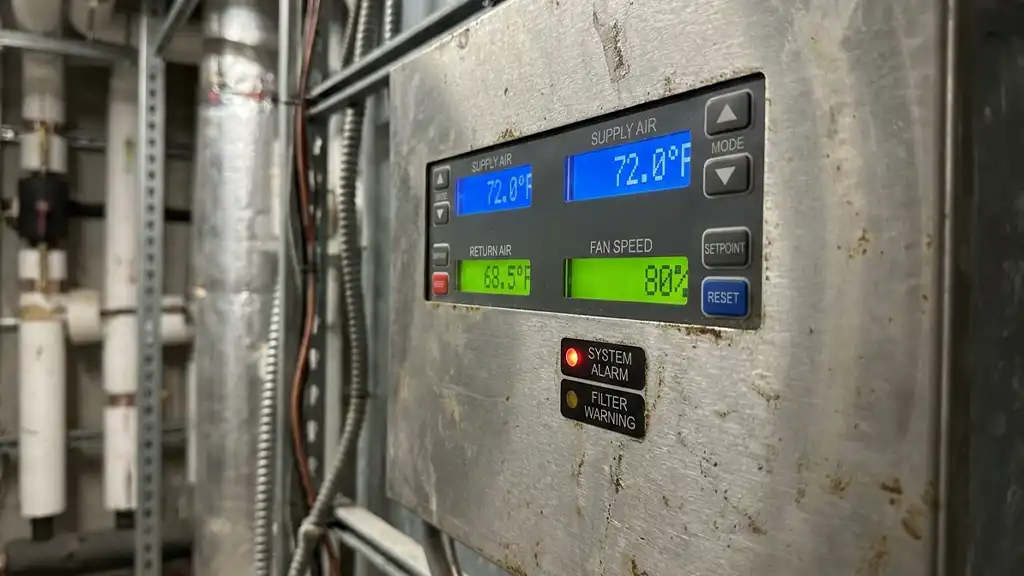
One of the biggest risks in warehouse HVAC is the system that appears to be running while the space quietly moves out of spec. Control faults, failed sensors, damper problems, and bad sequences may not shut the equipment off completely, which makes them easy to miss.
- Economizer and control faults can persist for months if nobody is actively monitoring them
- A sensor problem can push a space out of range without anyone seeing it right away
- Power outages can disable HVAC and monitoring at the same time
- One wall sensor is rarely enough for a large warehouse with hot and cold spots
This is why continuous monitoring matters. If the building loses cooling and visibility at the same time, teams may not know how much product was affected, for how long, or in which zones.
7. Downtime Response Needs To Be a Warehouse Operations Plan, Not Just a Service Call
Too many facilities respond to HVAC downtime as if it were only a maintenance issue. In warehouse operations, that is not enough. Once conditions drift, the response needs to connect facilities, operations, quality, and in some cases transportation and alternate storage.
- Identify which zones and products are most critical before an event happens
- Document who gets notified and who makes hold or release decisions
- Capture temperature, humidity, alarm history, and affected time windows during the incident
- Have backup plans for generators, temporary cooling, or alternate storage where appropriate
The strongest mitigation plans are layered. Monitoring, sensor calibration, disciplined preventive maintenance, alarm escalation, and formal emergency SOPs usually deliver the best return first. Higher-risk facilities may also need redundancy, backup power, and qualified alternate storage options.
8. Preventive Maintenance Still Delivers the Best ROI
Most warehouse operators do not need more drama in the middle of summer or winter. They need fewer preventable failures. That is where a disciplined maintenance program still delivers the best value.
- Routine inspections help catch mechanical wear before cooling or heating capacity collapses
- Sensor calibration and control review reduce the risk of “silent” out-of-spec conditions
- Coil cleaning, drain checks, belt inspection, and refrigerant integrity all matter more than they seem
- Maintenance closeout discipline matters just as much as opening the work order
In practice, this means maintenance should do more than generate tasks. It should reduce repeat faults, track critical equipment, and support faster recovery when something does go wrong.
With a Choice Mechanical maintenance agreement, your HVAC system stays more reliable, more efficient, and better supported year-round.
Request a quote or inspection today.
Frequently Asked Questions
How does HVAC downtime affect safety in warehouses?
Downtime can create unsafe heat, poor ventilation, humidity-related slip hazards, and reduced indoor air quality. In refrigerated environments, it can also contribute to cold stress and other safety issues.
Why are some HVAC failures more expensive than others?
The highest-cost events are often the ones that affect product quality, contamination, or compliance, not just the ones that break equipment. A smaller number of severe incidents can drive most of the annual loss.
How quickly can inventory be affected during a warehouse HVAC failure?
That depends on the product, storage conditions, and how much visibility the facility has. In refrigerated environments, the window can be measured in hours, not days.
What is the best way to prevent HVAC failures in warehouses?
Seasonal tune-ups, filter changes, coil cleaning, sensor calibration, control review, and continuous monitoring all play a role. The best results come from a maintenance plan that matches the facility’s actual risk level.
Protect Your Indiana Facility From HVAC Downtime Before It Becomes a Product, Safety, and Compliance Problem
HVAC downtime in a warehouse or distribution center is rarely just a temperature problem. It can affect throughput, worker safety, product integrity, sanitation, compliance exposure, and customer commitments all at once. In Indiana’s demanding climate, those risks show up fast.
That is why warehouses need more than basic service. They need a practical strategy that includes preventive maintenance, monitoring, controls, and a partner who can respond when conditions go sideways.
Choice Mechanical offers expert 24/7 emergency HVAC services tailored to commercial and industrial warehouses across the Indianapolis region.
Reach out today to build a proactive maintenance and response strategy that keeps your facility running and your risk under control.